The individual whom Mr Headstone had unceremoniously tumbled
into the street had the appearance of a person of good breeding, his suit of
clothes being one of the greatest marvels of sartorial elegance that the firm
of Burgess & Co. had ever turned out. Getting to his feet and brushing down
his trousers, the young gentleman assured the pedagogue that his condition was
of no consequence; that the dirt could be washed out and the rents at the knees
could be mended; and if they could not, it was still of no consequence as
Burgess could always run up another pair; and, if that gentleman happened to be
otherwise professionally engaged, then Co. would be sure to perform the service
with equal despatch. Mr Headstone felt obliged to the gentleman for such good
grace in the face of misfortune and would have shaken him by the hand as a
token of his appreciation had he not been required by immediate circumstance to direct his
attention to two other occurrences which had a direct bearing upon his own
well-being. The first was the application of a set of canine teeth to the rear
of his pantaloons, and the subsequent operation of those same teeth upon that sensitive
part of his anatomy. The second was the approach of an interesting character in
a shaggy white great-coat and flat-brimmed hat, who proceeded to knock him
about the head in that vigorous manner which is the hallmark of a professional
pugilist.
Exposed on both flanks, Mr Headstone was - like many a
famous general in military history - on the point of capitulation when aid came
from an unexpected quarter in the form of the young gentleman, who instructed
both man and beast to desist in their hostilities, which orders they at once
obeyed. The fray being over, the young gentleman handed the pedagogue a card –
of which he had a plentiful supply – bearing the name of Toots. Mr Headstone
returned the compliment and the two men shook hands warmly. Mr Toots intimated
that the character in the great-coat, who was always to be heard of at the bar
of the Black Badger, answered to his
professional moniker of the Game Chicken. Thus introduced, the Chicken dropped
his hat, made a dodge and a feint with his left hand, hit a supposed enemy a
violent blow with his right, shook his head smartly, and recovered himself. The
dog, whose bark indicated that he too desired an introduction, was called Diogenes,
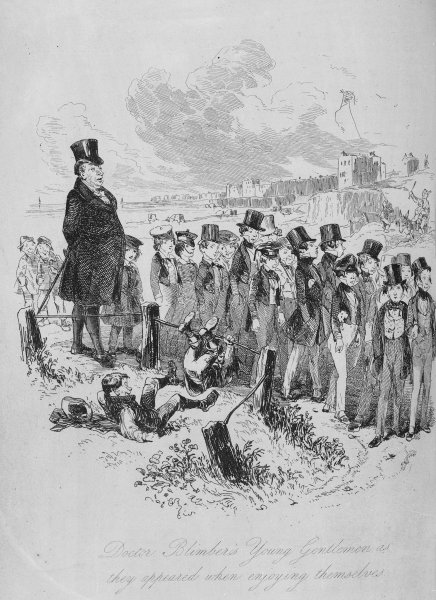
on account of his having been raised from a puppy in Doctor Blimber’s Academy
and having received - like Mr Toots, who was also an alumnus of that
institution - a classical education.
The Chicken was a stoical gentleman, with very short hair, a
broken nose, and a considerable tract of bare and sterile country behind each
ear. Mr Toots employed him as his chief instructor in the cultivation of those
gentle arts which refine and humanise existence; and the Game Chicken had
introduced to him a marker who taught billiards, a Life Guard who taught
fencing, a jobmaster who taught riding, a Cornish gentleman who was up to
anything in the athletic line, and two or three other friends connected no less
intimately with the fine arts. In Mr Toots’s Pantheon, however, the Game
Chicken was quite the Apollo, and he now demonstrated his prowess in the field
by dancing round the pedagogue and jabbing at the air with a swift double
motion of his gnarly fists.
Mr Toots was at that moment on his way to see the Chicken
defeat the Larkey Boy in a contest of ten rounds, and announced that he would
be honoured if, as a mark of their new-found friendship, Mr Headstone would
accompany him to witness the Chicken’s triumph, which was already being spoken
of as if it were a recorded fact. The pedagogue willingly accepted the
invitation and the two new acquaintances set out for Jack Randall’s in Chancery
Lane, with the Chicken dancing and sparring around them and Diogenes taking up
the rear, which latter fact caused Mr Headstone no small amount of trepidation
in respect of his pantaloons.