It was not until Mr Headstone determined to leave London by means of the one natural form of locomotion available to him that he began to realise the extent of that great metropolis. No matter for how long he walked, he still found himself confined by streets, still found himself within the haunts of commerce and great traffic, still found himself with pavement under his feet. At length, however, these streets, becoming more straggling, dwindled away, until there were only small garden patches bordering the road. To these succeeded pert cottages, with plots of ground in front, and then came the public-house, freshly painted green and white, with tea gardens and a bowling green; then fields; and then some houses, one by one, of goodly size with lawns. Then came a turnpike, through which the pedagogue passed without hindrance, and then fields, and then a hill; and on top of that hill he sat down to rest (still being under the influence of the 'old rosy') and looked back at the distant dome of Saint Paul's looming through the smoke.
Surveying the landscape below him, Mr Headstone's most singular observation to himself was that the countryside was very green in character, and that, as this was a colour which he did not entirely favour (with the exception of a velveteen jacket in his wardrobe), he could not immediately reconcile it to his notions of good taste. Where it was not green, it was predisposed to be brown, but this slight variation did nothing to recommend it to the pedagogue's good opinion. Indeed, as these two colours in combination invoked the image of his lawyer's sister, Miss Sally Brass, whose usual dress was a green gown and a brown gauze head-dress, and whose countenance even when in good humour was not of the most delicate kind, Mr Headstone could do nothing but scowl and grimace at the landscape below him, and wish for a more soothing prospect of soot-blackened brick and chimney pots.
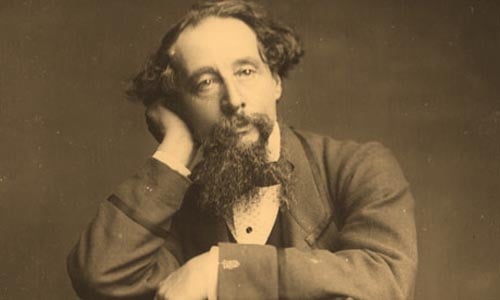
Mr Charles Dickens
Saturday, April 28, 2012
Tuesday, April 24, 2012
In Which Mr Headstone Bids Farewell To His Friends
Having determined to quit the metropolis for a sojourn in the country, Mr Headstone felt it incumbent upon himself to inform those whose company he regularly kept of his forthcoming absence lest they think he had been murdered in his bed or had enlisted into the regiment's service. He accordingly made straight for The George and Vulture, where he could be confident of finding some of his friends at breakfast. It being very early in the morning, the pedagogue was obliged to wait in the street for an hour before the landlord opened the doors, which time he profitably spent carving his initials into the pump across the way and pitching pebbles into the gutter. Once admitted he was again compelled to tarry until such customers that were among those of his acquaintance presented themselves at the bar.
If time can be measured in portions of liquor, then it was no longer than two pennyworth of brandy before Mr Dick Swiveller entered the establishment amidst a cloud of tobacco smoke and called for a tumbler of cold gin-and-water. He was shortly joined by Mr Fred Trent, who asked for a glass of the same, and these two worthy gentlemen joined Mr Headstone in their first - but certainly not their last - libation of the day. Being informed of the pedagogue's resolution to quit town, Mr Swiveller declared that he would not allow his friend to depart without a proper send-off, and to this end he proposed that they repair immediately to The Lamb and Flag, where they would be sure to find Mr Jingle. In this supposition Mr Swiveller was proved correct, and indeed in each subsequent prediction he made regarding the current whereabouts of a member of their company, the gentleman exhibited the powers of prognostication of an augury. Mr Tappertit was at The Grenadier, Mr Guppy was conning a bill from Chancery at The Old Mitre, Mr Folair was in The Coal Hole with his fellow thespians, and Mr Mantalini was being dazzled by the beauty of the barmaid at The George Inn. Once assembled, this motley crew drank a toast to Mr Headstone's venture and sent the pedagogue on his way, which, under the influence of brandy and porter, had now become a route of a peculiarly circuitous nature.
If time can be measured in portions of liquor, then it was no longer than two pennyworth of brandy before Mr Dick Swiveller entered the establishment amidst a cloud of tobacco smoke and called for a tumbler of cold gin-and-water. He was shortly joined by Mr Fred Trent, who asked for a glass of the same, and these two worthy gentlemen joined Mr Headstone in their first - but certainly not their last - libation of the day. Being informed of the pedagogue's resolution to quit town, Mr Swiveller declared that he would not allow his friend to depart without a proper send-off, and to this end he proposed that they repair immediately to The Lamb and Flag, where they would be sure to find Mr Jingle. In this supposition Mr Swiveller was proved correct, and indeed in each subsequent prediction he made regarding the current whereabouts of a member of their company, the gentleman exhibited the powers of prognostication of an augury. Mr Tappertit was at The Grenadier, Mr Guppy was conning a bill from Chancery at The Old Mitre, Mr Folair was in The Coal Hole with his fellow thespians, and Mr Mantalini was being dazzled by the beauty of the barmaid at The George Inn. Once assembled, this motley crew drank a toast to Mr Headstone's venture and sent the pedagogue on his way, which, under the influence of brandy and porter, had now become a route of a peculiarly circuitous nature.


Saturday, April 21, 2012
In Which Mr Headstone Decides To Commune With Nature
In devising his grand project to celebrate the bicentenary of the birth of Mr Charles Dickens, Mr Headstone had not anticipated how the daily business of life would interfere with his plans. The month of April was nearly over and almost one third of the time allotted to his task had run out. As he returned The Adventures of Nicholas Nickleby to its place and took down The Old Curiosity Shop, the pedagogue looked with dismay at the remaining unread volumes on the shelf. Like wealthy gentlemen of leisure they were inclined to be of large dimensions, and even the presence of one or two striplings amongst them did not compensate for the fact that the later works were of proportions to rival those of the celebrated Mr Daniel Lambert.
Mr Headstone had lately become aware that another gentleman (not of his acquaintance) was embarked on a similar endeavor to his own, and that he already had the advantage of the pedagogue by two novels clear. Spurred to action by these thoughts, Mr Headstone made a resolution to quit the noisome city and to seek the quiet and solitude of the countryside, where he could more easily devote himself to his task. He longed for the freshness of the day, the singing of the birds, the beauty of the waving grass, the deep green leaves, such simple pleasures being great joys to those who live solitarily in great cities as in the bucket of a human well.
The better to appreciate the wonders of nature (and to avoid the expense commonly incurred when travelling by other means), Mr Headstone elected to make his journey on foot, and so early one morning - as the sparkling sun beams of a new day were twinkling through blind and curtain before sleepers' eyes - the pedagogue set off.
Mr Headstone had lately become aware that another gentleman (not of his acquaintance) was embarked on a similar endeavor to his own, and that he already had the advantage of the pedagogue by two novels clear. Spurred to action by these thoughts, Mr Headstone made a resolution to quit the noisome city and to seek the quiet and solitude of the countryside, where he could more easily devote himself to his task. He longed for the freshness of the day, the singing of the birds, the beauty of the waving grass, the deep green leaves, such simple pleasures being great joys to those who live solitarily in great cities as in the bucket of a human well.
The better to appreciate the wonders of nature (and to avoid the expense commonly incurred when travelling by other means), Mr Headstone elected to make his journey on foot, and so early one morning - as the sparkling sun beams of a new day were twinkling through blind and curtain before sleepers' eyes - the pedagogue set off.
Tuesday, April 17, 2012
Being A Short Chapter And Not Worthy Of A Heading
Mr Headstone's attempts to catch up with the young gentleman who had demonstrated such antipathy towards the play were hindered by the movement of the people about him, who, in their various desires to greet acquaintances hailed from across the room or to gain egress from the auditorium by the least convenient exit, conspired to create a shifting mass of humanity, which - like a turbulent river - swept up everything in its path. When the pedagogue finally gained the street, the young gentleman was nowhere to be seen, which misfortune was to a degree alleviated by the fact that the same could be said of Messrs Pyke and Pluck. Taking advantage of the situation, Mr Headstone returned to his lodgings and spent the remainder of the evening emptying the lock boxes of their contents and contriving various ingenious means of secreting them in obscure nooks and crannies, much to the annoyance of Mrs Raddle, who expressed her dissatisfaction with the point of a broom handle on the ceiling of the room below, which was not entirely to the agreement of the tenant who lived there.
Wednesday, April 11, 2012
Being For The Benefit Of Mr Crummles
The gas lamps dimmed and the orchestra - which consisted of three fiddles, a bass drum and a trumpet - struck up a sprightly reel as the curtain rose to reveal the entire company in tableau, which prospect was greeted with much clapping of hands and much stamping of feet. The young theatrical gentleman had invited himself into Mr Headstone's box and was helping himself liberally to the refreshments provided, for which gracious hospitality he was most willing to offer recompense in the form of a gloss upon the proceedings taking place upon the stage. The play, he informed the pedagogue and his companions, was the latest work from the pen of a literary gentleman of great distinction, whose powers of imagination were widely believed to be second to none. In truth, the gentleman's powers of imagination were second to many for - lacking even the tiniest spark of the creative impulse - he had made his reputation by plundering the works of other authors and passing them off as his own.
The play now before them was entitled The Adventures of Nathan Knuckleboy, and told the affecting tale of a young man making his way in the world first as a schoolmaster, then as an actor, before finally achieving his life's dream of becoming a jobbing clerk. This upright youth was played by Mr Thomas Lenville, whose face was long, and very pale from the liberal application of stage paint, and whose voice declaimed his speeches of self-righteous indignation in strident tones. Mr Lenville was famed for his powers of articulation and projection, and the young theatrical gentleman assured the pedagogue that his every word could be plainly heard at the very back of the gallery - a phenomenon which Mr Headstone, being seated much closer to their point of origin, was in no position to dispute. The noble youth had a widowed mother, played by Mrs Crummles, and a noble sister, whose principal recommendation was her maidenly beauty. As the latter part had been taken by Miss Snevellicci, a willing suspension of disbelief was required from those members of the audience close enough to the stage to discern the good lady's features, which, alas, no longer had the bloom of youth upon them.
The plot was most interesting. Young Knuckleboy was employed by Mr Speers at a Yorkshire school for boys, but rebelled against the harshness of the place and the cruelty of his master and fled with an idiot boy called Spike. Together they fell into the company of a group of travelling players, where they quickly became celebrated for their thespian talents. Meanwhile in London the noble sister was subjected to the unwonted attentions of an unscrupulous aristocrat (aided and abetted by her devious uncle), but was finally delivered to safety by her brother, who returned to the capital and was immediately taken under the wing of a pair of cherubic twins, who were successful in trade. The evil uncle plotted to ruin the life of another beauty by wedding her to an old miser and dispossessing her of her rightful inheritance, but was foiled by young Knuckleboy, who fell in love with the fair maid and married her instead.
Amidst the melodrama, there were interludes of dance performed by the Infant Phenomenon, demonstrations of prestidigitation exhibited by the African Swallower, and - much to the delight of the young theatrical gentleman - scenes of comic invention from Mr Folair, who, with the aid of a mangle and an iron skillet, suffered a series of indignities on the villains of the piece, which services were performed to the great satisfaction of the audience. When the final curtain came down, after a protracted death scene in which the character of the evil uncle (as played by Mr Crummles himself) staggered about the stage and apostrophised the furniture (it being a soliloquy) before expiring to such applause that he was obliged to revive himself and repeat the performance from the beginning, the whole house rose to its feet in appreciation.
Mr Headstone observed that amidst the universal approbation of the play, there was one individual who occupied the box across the way and gave every sign of dissatisfaction with the performance. He was a youthful gentleman, with a fresh face and an abundance of thick flowing hair, and he sat resolutely with his arms folded until the author of the piece came upon the stage to take his bow - at which point he rose from his seat and shook his fist with great vehemence. Much intrigued by these expressions of emotion, Mr Headstone determined to speak with this gentleman, and, as the audience broke up, he pressed his way through the crowd towards him.

The play now before them was entitled The Adventures of Nathan Knuckleboy, and told the affecting tale of a young man making his way in the world first as a schoolmaster, then as an actor, before finally achieving his life's dream of becoming a jobbing clerk. This upright youth was played by Mr Thomas Lenville, whose face was long, and very pale from the liberal application of stage paint, and whose voice declaimed his speeches of self-righteous indignation in strident tones. Mr Lenville was famed for his powers of articulation and projection, and the young theatrical gentleman assured the pedagogue that his every word could be plainly heard at the very back of the gallery - a phenomenon which Mr Headstone, being seated much closer to their point of origin, was in no position to dispute. The noble youth had a widowed mother, played by Mrs Crummles, and a noble sister, whose principal recommendation was her maidenly beauty. As the latter part had been taken by Miss Snevellicci, a willing suspension of disbelief was required from those members of the audience close enough to the stage to discern the good lady's features, which, alas, no longer had the bloom of youth upon them.
The plot was most interesting. Young Knuckleboy was employed by Mr Speers at a Yorkshire school for boys, but rebelled against the harshness of the place and the cruelty of his master and fled with an idiot boy called Spike. Together they fell into the company of a group of travelling players, where they quickly became celebrated for their thespian talents. Meanwhile in London the noble sister was subjected to the unwonted attentions of an unscrupulous aristocrat (aided and abetted by her devious uncle), but was finally delivered to safety by her brother, who returned to the capital and was immediately taken under the wing of a pair of cherubic twins, who were successful in trade. The evil uncle plotted to ruin the life of another beauty by wedding her to an old miser and dispossessing her of her rightful inheritance, but was foiled by young Knuckleboy, who fell in love with the fair maid and married her instead.
Amidst the melodrama, there were interludes of dance performed by the Infant Phenomenon, demonstrations of prestidigitation exhibited by the African Swallower, and - much to the delight of the young theatrical gentleman - scenes of comic invention from Mr Folair, who, with the aid of a mangle and an iron skillet, suffered a series of indignities on the villains of the piece, which services were performed to the great satisfaction of the audience. When the final curtain came down, after a protracted death scene in which the character of the evil uncle (as played by Mr Crummles himself) staggered about the stage and apostrophised the furniture (it being a soliloquy) before expiring to such applause that he was obliged to revive himself and repeat the performance from the beginning, the whole house rose to its feet in appreciation.
Mr Headstone observed that amidst the universal approbation of the play, there was one individual who occupied the box across the way and gave every sign of dissatisfaction with the performance. He was a youthful gentleman, with a fresh face and an abundance of thick flowing hair, and he sat resolutely with his arms folded until the author of the piece came upon the stage to take his bow - at which point he rose from his seat and shook his fist with great vehemence. Much intrigued by these expressions of emotion, Mr Headstone determined to speak with this gentleman, and, as the audience broke up, he pressed his way through the crowd towards him.

Monday, April 9, 2012
In Which Mr Headstone Meets A Theatrical Young Gentleman
The interior of the theatre had a strong smell of orange peel and lamp oil, with an undercurrent of sawdust, which - together with the individual odours of the patrons perspiring under the heat of the gas lamps - competed vigorously for Mr Headstone's olfactory attentions. Grateful that he had secured the privacy of a box for himself and his companions, the pedagogue gave the number to the assistant box-keeper and followed him, pausing only to exchange words with those individuals upon whose feet he inadvertently trod or whose eyes he unwittingly elbowed. One burly patron who received both of these attentions expressed his dissatisfaction with the arrangement by threatening to 'smilfligate' any man who took such another liberty, and might indeed have made good his word - whatever his word meant - had not a young gentleman come to Mr Headstone's aid and guided him without further incident to his box.
This individual was by his own admission a theatrical young gentleman, and had an infinite relish for all pieces which displayed the fullest resources of the establishment. In this respect, he assured Mr Headstone that Mr Vincent Crummles of Provincial Celebrity would not disappoint. In a recent performance in Portsmouth he had contrived to work in a real pump and two washing-tubs into a performance of Romeo and Juliet, which addition the celebrated critic Mr Curdle had proclaimed as 'an exquisite embodiment of the poet's visions.' As it was well known in theatrical circles that Mr Crummles had recently acquired several new items of ironmongery, the evening's performance was greatly anticipated.
This individual was by his own admission a theatrical young gentleman, and had an infinite relish for all pieces which displayed the fullest resources of the establishment. In this respect, he assured Mr Headstone that Mr Vincent Crummles of Provincial Celebrity would not disappoint. In a recent performance in Portsmouth he had contrived to work in a real pump and two washing-tubs into a performance of Romeo and Juliet, which addition the celebrated critic Mr Curdle had proclaimed as 'an exquisite embodiment of the poet's visions.' As it was well known in theatrical circles that Mr Crummles had recently acquired several new items of ironmongery, the evening's performance was greatly anticipated.
Subscribe to:
Comments (Atom)