The gas lamps dimmed and the orchestra - which consisted of three fiddles, a bass drum and a trumpet - struck up a sprightly reel as the curtain rose to reveal the entire company in tableau, which prospect was greeted with much clapping of hands and much stamping of feet. The young theatrical gentleman had invited himself into Mr Headstone's box and was helping himself liberally to the refreshments provided, for which gracious hospitality he was most willing to offer recompense in the form of a gloss upon the proceedings taking place upon the stage. The play, he informed the pedagogue and his companions, was the latest work from the pen of a literary gentleman of great distinction, whose powers of imagination were widely believed to be second to none. In truth, the gentleman's powers of imagination were second to many for - lacking even the tiniest spark of the creative impulse - he had made his reputation by plundering the works of other authors and passing them off as his own.
The play now before them was entitled The Adventures of Nathan Knuckleboy, and told the affecting tale of a young man making his way in the world first as a schoolmaster, then as an actor, before finally achieving his life's dream of becoming a jobbing clerk. This upright youth was played by Mr Thomas Lenville, whose face was long, and very pale from the liberal application of stage paint, and whose voice declaimed his speeches of self-righteous indignation in strident tones. Mr Lenville was famed for his powers of articulation and projection, and the young theatrical gentleman assured the pedagogue that his every word could be plainly heard at the very back of the gallery - a phenomenon which Mr Headstone, being seated much closer to their point of origin, was in no position to dispute. The noble youth had a widowed mother, played by Mrs Crummles, and a noble sister, whose principal recommendation was her maidenly beauty. As the latter part had been taken by Miss Snevellicci, a willing suspension of disbelief was required from those members of the audience close enough to the stage to discern the good lady's features, which, alas, no longer had the bloom of youth upon them.
The plot was most interesting. Young Knuckleboy was employed by Mr Speers at a Yorkshire school for boys, but rebelled against the harshness of the place and the cruelty of his master and fled with an idiot boy called Spike. Together they fell into the company of a group of travelling players, where they quickly became celebrated for their thespian talents. Meanwhile in London the noble sister was subjected to the unwonted attentions of an unscrupulous aristocrat (aided and abetted by her devious uncle), but was finally delivered to safety by her brother, who returned to the capital and was immediately taken under the wing of a pair of cherubic twins, who were successful in trade. The evil uncle plotted to ruin the life of another beauty by wedding her to an old miser and dispossessing her of her rightful inheritance, but was foiled by young Knuckleboy, who fell in love with the fair maid and married her instead.
Amidst the melodrama, there were interludes of dance performed by the Infant Phenomenon, demonstrations of prestidigitation exhibited by the African Swallower, and - much to the delight of the young theatrical gentleman - scenes of comic invention from Mr Folair, who, with the aid of a mangle and an iron skillet, suffered a series of indignities on the villains of the piece, which services were performed to the great satisfaction of the audience. When the final curtain came down, after a protracted death scene in which the character of the evil uncle (as played by Mr Crummles himself) staggered about the stage and apostrophised the furniture (it being a soliloquy) before expiring to such applause that he was obliged to revive himself and repeat the performance from the beginning, the whole house rose to its feet in appreciation.
Mr Headstone observed that amidst the universal approbation of the play, there was one individual who occupied the box across the way and gave every sign of dissatisfaction with the performance. He was a youthful gentleman, with a fresh face and an abundance of thick flowing hair, and he sat resolutely with his arms folded until the author of the piece came upon the stage to take his bow - at which point he rose from his seat and shook his fist with great vehemence. Much intrigued by these expressions of emotion, Mr Headstone determined to speak with this gentleman, and, as the audience broke up, he pressed his way through the crowd towards him.
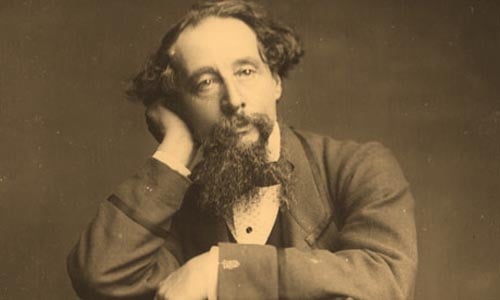
Mr Charles Dickens