It was not until Mr Headstone determined to leave London by means of the one natural form of locomotion available to him that he began to realise the extent of that great metropolis. No matter for how long he walked, he still found himself confined by streets, still found himself within the haunts of commerce and great traffic, still found himself with pavement under his feet. At length, however, these streets, becoming more straggling, dwindled away, until there were only small garden patches bordering the road. To these succeeded pert cottages, with plots of ground in front, and then came the public-house, freshly painted green and white, with tea gardens and a bowling green; then fields; and then some houses, one by one, of goodly size with lawns. Then came a turnpike, through which the pedagogue passed without hindrance, and then fields, and then a hill; and on top of that hill he sat down to rest (still being under the influence of the 'old rosy') and looked back at the distant dome of Saint Paul's looming through the smoke.
Surveying the landscape below him, Mr Headstone's most singular observation to himself was that the countryside was very green in character, and that, as this was a colour which he did not entirely favour (with the exception of a velveteen jacket in his wardrobe), he could not immediately reconcile it to his notions of good taste. Where it was not green, it was predisposed to be brown, but this slight variation did nothing to recommend it to the pedagogue's good opinion. Indeed, as these two colours in combination invoked the image of his lawyer's sister, Miss Sally Brass, whose usual dress was a green gown and a brown gauze head-dress, and whose countenance even when in good humour was not of the most delicate kind, Mr Headstone could do nothing but scowl and grimace at the landscape below him, and wish for a more soothing prospect of soot-blackened brick and chimney pots.
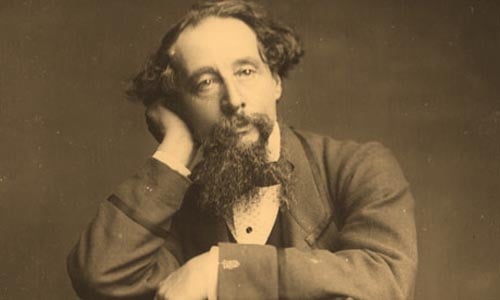
Mr Charles Dickens