London.
The month of October almost over, and Mr Headstone is sitting in his room in
front of a glowing coal fire, an open book upon his lap, and a glass of Old Tom
at his elbow. Outside it is bitterly cold and there is as much murk and gloom
in the streets as if the ancient shades of creation’s first night had not yet
withdrawn from the face of the earth, and it would not be wonderful to meet a crook-backed
homunculus shuffling down the Strand. Dogs
howl at the moon, which peers down through drifting tattered clouds. A black
cat jumps onto a graveyard wall, arches its back and stares with wide green
eyes at something moving between the tombs. Horses whinny and shy at the least
provocation, their hooves striking sparks on the wet cobbles. Foot passengers,
wrapped up in coats and scarves, gliding through the streets, their footfalls
muffled by the clammy atmosphere, come and go like the spirits of the departed.
It is weather for neither man nor beast, and so Mr Headstone is making himself comfortable by the fireside with the intention of
whiling away the evening in the perusal of three ghost stories by Mr Dickens, these short works being the most appropriate form of entertainment for the season.
Shadows everywhere. Shadows creeping over the domes and spires of the city; shadows
settling on the rooftops of the great houses between Portland Place and
Bryanstone Square; shadows, blacker than a judge’s cap, filling up the courts
of Gray’s Inn; shadows engulfing the humbler dwellings of Camden Town and
Staggs’s Garden; shadows finding every nook and every cranny of every crooked
alleyway, and seeping even into the cracks of the newly laid paving stones. Shadows
in the very room where Mr Headstone sits alone, looking nervously over his
shoulder as he puts down his book, imagining he sees something crouching in the
corner, which - on closer investigation - turns out to be nothing more menacing
than the coal scuttle. Hark! Is that a scratching at the window? Is that a
rustling under the chair? Is that a footfall on the stair? Do the pedagogue’s
eyes deceive him, or is the doorknob slowly turning as if someone – or
something – wanted to come in? The door creaks slowly open on its hinges, but
what apparition stands there? Is it a pale sheeted ghost risen up from the
grave come to haunt the trembling pedagogue? No, it is Mrs Raddle delivering
the weekly supply of freshly laundered linen, and come to remind Mr Headstone
that his rent his due on Saturday.
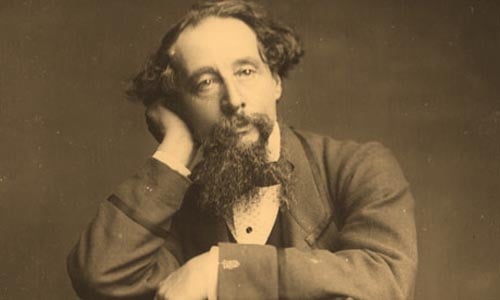
Mr Charles Dickens
Wednesday, October 31, 2012
Monday, October 29, 2012
In Which Mr Headstone Is Restored To Domestic Bliss
It will be a matter of some surprise for the reader to learn
that during Mr Headstone’s prolonged absence his landlady had failed to find another
tenant for the rooms that he had vacated. Although a number of single gentlemen
had walked up in response to the advertisement placed in the scullery window,
none of them had been able to reconcile the peculiarities of that attic
apartment with their notions of domestic comfort. First, there were the stairs
to contend with, which creaked underfoot like the deck of a three-masted
schooner, and wound in ever-tightening circles to just below the roof, where
inconvenient buttresses of brick and plaster and low-hanging beams of hard wood
awaited the unsuspecting crown of any visitor. The interior of the rooms was in
much the same condition as Mr Headstone had left it on his departure; that is
to say, in a state of confusion and disarray. The carpet waited patiently to
snare the tread of any unwary traveller across the floor; the footstool lounged
insouciantly on its three uneven legs, eager for an opportunity to upset the
weary guest in search of repose; the fireplace frowned darkly, and, when the
wind got up outside, sneezed smudges of greasy soot into the air; the sofa
sagged dropsically as if inclined to extended bouts of melancholy, and
exhibited the symptoms of advanced old age in its effusive sprouting of
horsehair through the tears and rents in its wrinkled hide. Cobwebs, with husks
of bluebottles in their nets, hung in the high corners where the landlord
spiders awaited more tenants. The walls were cold and clammy, like gravestones
to the touch. But to Mr Headstone, it was still home, and when he threw open
the door and surveyed everything before him, tears rolled down his cheeks –
which may have been engendered by the emotion of his return, or – as is more
likely – by the operation of the strong odours of dead fish and old beer on his
eyes.

Sunday, October 28, 2012
In Which Mr Headstone Makes Known His Suspicions
From the very instigation of his grand design to run through the collected works of the Inimitable Author, Mr Headstone had become aware of an alteration in the circumstances of his life, which, as his project progressed, seemed to encroach increasingly on his daily existence. Every man and every woman is subject to their fair share of misfortune, and none but the vain and the mighty can expect to escape the minor trials of life. Mr Headstone, however, was now of the opinion that he had recently been allotted a much larger serving of bad luck than he could possibly be expected to consume, and that he was - with regard to misfortune - developing a severe case of dyspepsia. Furthermore, he had begun to form a suspicion in his own mind that some invisible hand was at work in arranging his encounters with recalcitrant servants, scheming villains, shrewish landladies, tyrannical magistrates & co., and that even the behaviour of inanimate objects was being orchestrated to conspire against him.
On hearing of the pedagogue's complaint, certain members of the assembled company did their best to alleviate Mr Headstone of his delusions. Mr Dick Swiveller took it as a great joke, and laughed at the notion. Mr Simon Tappertit pronounced it as the onset of lunacy, and advised the gentleman to make immediate arrangements for the transference of his belongings and his good self to the Bethlem Royal Hospital. Mr Guppy perceived the situation as an opportunity for taking out an action, and pressed for more details. Only, Mr Mould, whose intellect was equal to the absurdity of the premise, advised Mr Headstone to do the one thing that would put his mind at rest - which was to seek out Mr Dickens and confront him with the charge of willful manipulation of character. This course of action was applauded by all, and Mr Headstone announced his intention to call upon the literary gentleman the very next day.
On hearing of the pedagogue's complaint, certain members of the assembled company did their best to alleviate Mr Headstone of his delusions. Mr Dick Swiveller took it as a great joke, and laughed at the notion. Mr Simon Tappertit pronounced it as the onset of lunacy, and advised the gentleman to make immediate arrangements for the transference of his belongings and his good self to the Bethlem Royal Hospital. Mr Guppy perceived the situation as an opportunity for taking out an action, and pressed for more details. Only, Mr Mould, whose intellect was equal to the absurdity of the premise, advised Mr Headstone to do the one thing that would put his mind at rest - which was to seek out Mr Dickens and confront him with the charge of willful manipulation of character. This course of action was applauded by all, and Mr Headstone announced his intention to call upon the literary gentleman the very next day.
Sunday, October 14, 2012
In Which Mrs Gamp Applies Another Remedy
When a gentleman’s complexion grows paler than a sheet of
freshly laundered linen, then it is common practice to stimulate the flow of
blood to those areas which - when rosy - are taken to be an outward indication
of rude health. Mrs Gamp’s preferred method for achieving this end was to apply
the flat and the back of her palm in a vigorous fanning motion about the face
of the patient, which operation was invariably guaranteed to bring the colour back
to the cheeks as swiftly as could be desired. The gin bottle now being empty, the
nurse lost no time in demonstrating the efficacy of this remedy by advancing on
Mr Headstone, grasping him by his buttonhole, and beating him about the
head in the aforementioned manner.
Having been restored to his former self by the application
of a dozen blows, Mr Headstone staggered back into a chair, the better to compose himself. Around him gathered
an assembly of his friends and acquaintances, all eager to know what had
precipitated his sudden expression of alarm at the mention of Mr Charles Dickens,
and all urging the pedagogue to unburden himself of his secret for - as Mr Winkle
remarked - a problem shared was a problem halved; or, in the case of the
present company, divided into equal portions of one seventeenths. Subdued by the
irrefutable argument of mathematics, Mr Headstone surveyed the expectant faces looming
before him, and, in a manner that was not entirely consistent with logic or
intelligibility, explained his predicament.
Subscribe to:
Comments (Atom)