The time of year
being apposite to the making of resolutions, Mr. Headstone determined to resign
his apprenticeship under Mr. Cruncher, and to look for more congenial employment.
The schoolmaster together with his friends and acquaintances had gathered, as
was their custom, at The Saracen’s Head to
bid farewell to the old year and to welcome in the new. The pot boy was being kept
in a state of perpetual motion, bringing in from the kitchen first some
oysters, and then a pair of roast fowls, together with potatoes boiled and
roasted, followed by a dish of stewed beef with vegetables, and a raised pie
and a dish of kidneys, and then a tart and a shape of jelly, and, last but not
least, the cheese and the celery. Whilst in the execution of these duties, the
pot boy was hailed at regular intervals by members of the party for the
provision of a quart of ale, a pint of champagne, a bowl of gin punch, a round
of sherry cobblers, a flask of brandy, a pint of red wine, and a pint of white,
and various other sundries. Having apprised the company of his present
difficulties, Mr. Headstone was gratified to be in receipt of a number of
suggestions with regard to his future prospects. Mr. Guppy advised him to try
the Bar; Mr. Benjamin Allen and Mr. Bob Sawyer were in favour of the medical
profession; Mr. Richard Swiveller claimed that the life of a jobbing clerk was
not without its attractions. But of all the proffered suggestions he received,
the schoolmaster was most taken with that of Mr. Micawber, who assured him that
if he did nothing but wait, something was bound to turn up.
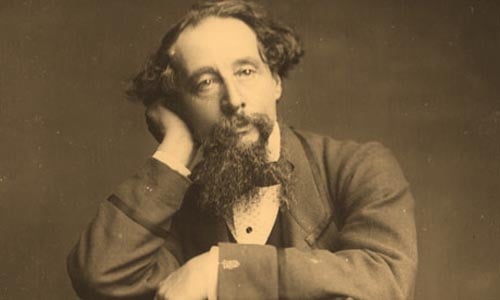
Mr Charles Dickens
Tuesday, December 31, 2013
Monday, December 30, 2013
In Which Mr Headstone is Reunited with a Late Acquaintance
Mr. Headstone and
his two fellow tradesmen began to dig and the sound of their spades at work
echoed around the churchyard. Presently Mr. Cruncher took from the sack an
instrument like a great corkscrew, which he adjusted with a practiced hand.
Whatever tools they worked with, they worked hard, until the awful striking of
the church clock so terrified the schoolmaster that he felt the hairs on his
head and even the bristles on his chin stiffen. He seemed resolved to abandon
his new trade before he had truly begun it, and would have made off that
instant had not his companions assured him that their work was almost done. Mr.
Cruncher dropped down into the opened grave, and there was a screwing and
complaining sound down below before he again emerged. Mr. Headstone took hold
of a length of rope proffered to him, and all three tradesmen pulled.
By slow degrees a great weight broke away
from the earth upon it, and came to the surface. Mr. Headstone very well knew
what it would be; but, when he saw it, and saw Mr. Cruncher about to wrench it
open, he was so frightened, being new to the sight, that his other companion
was obliged to stop his mouth with a quantity of hessian to prevent his cries
from alerting the sexton. The coffin was propped up against the marble stone in
order that Mr. Cruncher could apply his crowbar. This he did with little
ceremony and to the sound of splintering mahogany he forced open the casket’s
heavy lid to reveal the tenant within.
Imagine Mr. Headstone’s surprise when, compelled
by the strangeness of the circumstance to look upon the unfortunate subject of
their labours, he recognised the features to be those of none other than the
late Mr. Merdle. As the departed are beyond the approbation of Society, Mr.
Headstone reasoned that no introductions were necessary, and so he assisted his
companions in removing the gentleman from his state of repose and wrapping him
in a winding sheet. Thus concealed, the body was transported to the gate and by
means of an ingenious system of pulleys hauled over to the other side. The
whole operation was greatly facilitated by the fact that the rigors of death
had taken full effect, and their burden was as easy to carry as a length
of timber.
Before delivering their prize up to two
young medical men, who were desirous of such specimens for the furthering of
their education, the three honest tradesmen went through the corpse’s pockets,
and were rewarded with the discovery of a gold watch, a silver snuff box, and other
sundry items. These spoils were divided up, and Mr. Headstone received as his
share a tortoise shell-handled penknife, which, he reflected, as he walked home
in the early morning light, was a remarkable instance of poetic justice.

Sunday, December 29, 2013
In Which Mr Headstone Learns the Nature of an Honest Trade
Mr. Cruncher’s apartments were not
in a savoury neighbourhood, and were but two in number, decently kept by a woman
of orderly and industrious appearance, who rejoiced in the title of Mrs.
Cruncher. When Mr. Headstone gave a double knock on the door at the appointed
time, he inadvertently interrupted the lady of the house in the cleaning of her
husband’s boots. As was his custom, Mr. Cruncher sat by the fire, devoting
himself to keeping a most vigilant watch on his wife, and sullenly holding her
in conversation that she might be prevented from meditating any petitions to
his disadvantage. For Mrs. Cruncher did not approve of her husband’s trade, and
could be most aggravating on the subject – to such a degree, in fact, that Mr.
Cruncher was obliged to keep an iron pot-lid by him as a projectile for the
correction of opinions contrary to his own. The honest tradesman invited his
new apprentice to take a seat, explaining that they would not start upon their
excursion until one o’clock, that hour of darkness being best suited to their
purpose.
Towards that small and ghostly hour, Mr. Cruncher rose up from his
chair, took a key out of his pocket, opened a locked cupboard, and brought
forth a sack, a crowbar of convenient size, a rope and chain, and other
implements of that nature. Disposing these articles about him in a skillful
manner, he bestowed a parting defiance on Mrs. Cruncher, extinguished the
light, and, bidding Mr. Headstone to follow, went out.
Within half an hour from the first starting, they were beyond the
winking lamps and out upon a lonely road, where another practitioner of the
trade was waiting to join them. The three went on until they stopped under a
bank overhanging the road. Upon the top of the bank was a low brick wall,
surmounted by an iron railing. In the shadow of bank and wall they turned out
of the road, and up a blind lane, of which the wall – there, risen to some
eight or ten feet high – formed one side.
Halfway down the lane they came to an iron gate, which was locked. Mr.
Headstone, who as the apprentice of the group had been deputised to carry the
sack, was grateful of the opportunity to set down his load. The disturbance
this occasioned – for the sack contained a quantity of ironmongery – appeared
to alarm his two companions, who looked up and down the lane as if they
expected an immediate hue and cry. The night was still and with the exception
of the shivering call of an owl and the distant bark of a dog all was quiet.
Mr. Headstone peered through the bars of the gate and descried amongst the rank
grass the rounded hulking shapes of gravestones, whitened by the moonlight.
Before the schoolmaster could ask Mr. Cruncher what business brought
them to a churchyard in the dead of night, that honest tradesman had nimbly
scaled the gate and dropped softly on the hallowed ground on the other side. He
motioned for his companions to follow, which they did; one with ease, as if he
were accustomed to the action; the other with difficulty, accompanied by a
further cacophony of ironmongery. Mr. Cruncher led the way amongst the tombs
until they came to a large grave of marble. The freshly turned earth beneath
the stone suggested that the occupant of the plot had but recently settled in
the neighbourhood. The honest tradesman now took command of the sack and from
it produced three spades, which he distributed. On receiving his
implement and being urged to start digging, Mr. Headstone realized what
business he was about, and that his new trade lay in the resurrection line.
Saturday, December 28, 2013
In Which Mr Headstone Encounters an Honest Tradesman
Returned to a state of pecuniary
uncertainty and finding himself in need of employment, Mr. Headstone began to
cast around for a suitable position. As a certificated schoolmaster, he had all
reasonable expectation of finding a post commensurate with both his needs and
his talents. However, as the former exceeded the latter by some significant
margin, he was bound to be disappointed; and a series of unsuccessful
interviews in which he demonstrated fully the extent of his limitations without
once exhibiting his potential left him morose and dejected. In such circumstances,
Mr. Headstone had but one recourse to satisfaction, and that he found behind
the bar of The Saracen’s Head.
One forenoon as the schoolmaster sat contemplating his future, which he appeared
to divine in the dregs of his emptied glass, there entered a stranger, looking
extremely red-eyed and grim, as if he had been up all night at a party which
had taken anything but a convivial turn. This individual called for a pint of
ale and a broiled fowl, and sat himself down opposite the schoolmaster to await
his repast. When the meal came, he worried over rather than ate it, growling
like any four-footed inmate of a menagerie, tearing the flesh from the bone
with his crooked yellow teeth and letting the grease run down his chin as if it
were a requisite lubricant for the savage action of his jaws. Mr. Headstone
attended the operation with a fascination born out of hunger, and was so
particular in his observation that the diner could not allow it to go
unchallenged.
Apprised of the schoolmaster’s desperate situation, the stranger pushed
the remains of ragged uneaten meat across the table and invited Mr. Headstone
to partake, which that gentleman did with all the evidence of a voracious
appetite. The feast having been concluded to the satisfaction of both parties,
the stranger drew out a pipe and lit it, and introduced himself as ‘a honest
tradesman’ by the name of Jerry Cruncher. Ruminating on his tobacco, which was
a necessary aid to digestion, Mr. Cruncher asked Mr. Headstone if he was
willing to learn an honest trade that required only light labour and was guaranteed
to turn a tidy profit. The schoolmaster’s reply being in the affirmative, Mr.
Cruncher then asked if Mr. Headstone objected to a little night work. Mr. Headstone
did not object, if it were absolutely necessary to the success of the
enterprise, which Mr. Cruncher assured him that it was. The terms and
conditions of employment were thus agreed, and the two men parted company with
a resolution to meet again at Mr. Cruncher’s private lodging in Hanging-sword-alley,
Whitefriars, at half-past ten of the clock that very evening.
Saturday, December 21, 2013
In Which The Death of a Great Man is Announced
When Society sat down to breakfast
and unfolded the newspaper to learn of the death of the great and wonderful
philanthropist Merdle, it was almost overcome by a severe fit of choking.
Whether this was occasioned by the unchecked expression of spontaneous emotion
or a dry piece of toast cannot be definitively said, but certain it was that when
Society rose from the table it had mastered its grief (or swallowed its toast),
and was prepared to apostrophise the departed spirit of benevolence with those
self same expressions of regard with which it had anointed the mortal shell.
The report that the great man was dead got about with astonishing
rapidity. At first, he was dead of all the diseases that ever were known, and
of several bran-new maladies invented to meet the occasion. By about eleven
o’clock in the forenoon, something the matter with the brain, became the
favourite theory against the field; and by twelve the something had been
distinctly ascertained to be ‘Pressure’. There was a general moralizing upon
Pressure, in every street. All the people who had tried to make money and had
not been able to do it, said, There you were! You no sooner began to devote
yourself to the pursuit of wealth than you got Pressure. But, at about the time
of High ‘Change, Pressure began to wane, and appalling whispers to circulate
east, west, north, and south; and by evening it was known that the late Mr.
Merdle’s complaint had been simply Forgery and Robbery, and that he had
destroyed himself by means of a bottle of laudanum and a tortoise-shell handled
penknife.
As soon as there arose a doubt that Mr. Merdle’s wealth would not be
found to be as vast as had been supposed, Society opined the view that it had
always suspected as much, and that there had been something about the man that
it had never trusted. His eyes had been set too close together, his
handshake had been infirm, his gait evasive, his manner sly. Only the servile
worshipper of riches could have mistaken his sumptuous display of wealth for substance.
Satisfied with its perspicacity, Society sat down to dinner, and ate well.
Numbers of men in every profession and trade would be blighted by Mr.
Merdle’s insolvency, and, as the creditors circled around the carcass of the
fallen man’s ruin, those who had deposited their money and their trust in him – amongst them, Mr. Headstone – found themselves dispossessed of
both their belongings and their credulity.
Saturday, December 14, 2013
In Which Mr Headstone Agrees to a Great Investment and a Small Loan
There never was, there never had
been, there never again should be, such a man as Mr. Merdle. According to his
physician, he had the constitution of a rhinoceros, the digestion of an
ostrich, and the concentration of an oyster. According to the City, he was
possessed of the riches of Croesus and in his financial dealings he was guided
by the wisdom of Solomon. Small wonder then that Mr. Headstone should feel the honour
of being invited by the great man into an adjoining library for a private
conversation. The room was a large one, and smelt of mahogany and leather,
which - to noses unaccustomed to them - are the olfactory emblems of tradition
and security.
Mr. Merdle had heard of Mr. Headstone’s recent good fortune and was desirous
of doing the gentleman a service by assisting him in the laying out of his
money. There would, of course, be the strictest integrity and uprightness in
these transactions, and between the parties concerned there must be the purest
faith and unimpeachable confidence, or the business could not be carried
forward. Mr. Headstone was greatly affected by this statement of integrity, and
wishing to prove himself equal to the contract at once made Mr. Merdle the sole
executor of his financial affairs.
The business being concluded with a handshake and a glass of brandy, Mr.
Headstone was about to rejoin the party in the other room when his host asked if
he was in the habit of carrying a penknife about his person. This instrument
being one of necessity to a schoolmaster, Mr. Headstone produced a knife with a
tortoise-shell handle, and opened the blade to demonstrate that it had but
recently been sharpened. Mr. Merdle asked if he might borrow it for a while as
he had a need of a knife, and had misplaced his own. He promised that it would
be returned in a day or two, and that he would undertake not to ink it.
Friday, November 22, 2013
In Which Mr Headstone Pays Court To The Great And Wonderful Merdle
Of all man’s accomplishments, none
is more coveted by Society that the ability to create capital. Consequently, no
man is held in higher esteem by Society than Mr. Merdle, who is immensely rich;
a man of prodigious enterprise; a Midas without ears, who turns all he touches
to gold. He is in everything good, from
banking to building. He is in Parliament, of course. He is in the City,
necessarily. He is Chairman of this, Trustee of that, President of the other. He
is a philanthropist, and a true friend to the Common Man, whom he employs in
vast numbers in his factories and in his foundries and in his mines, and pays
them withal for the privilege.
Mr. Merdle was wont to acknowledge
the tributes Society laid before him by inviting it in its multifarious forms to dine at his
establishment in Harley Street,
Cavendish Square.
There gathered magnates from the Court and magnates from the City, magnates
from the Commons and magnates from the Lords, magnates from the Bench and
magnates from the Bar, Bishop magnates, Treasury magnates, Horse Guard
magnates, Admiralty magnates; and amongst all these magnates was Mr. Headstone,
whose fortune had elevated him to such a height that he was quite dizzy when he
viewed the prospect before him. The talk that evening was of Mr. Merdle’s most
recent acquisition. The Bishop magnate had heard the figure of a hundred
thousand pounds. Horse Guards had heard two. Treasury had heard three. Mr.
Headstone, not wishing to be outdone by the present company, increased the
stakes to five, and instantly won the admiration of his circle - for if anything,
Society was more impressed by the display of wealth than the acquisition of it.
Tuesday, November 5, 2013
Containing The Whole Science Of Government
Barnacle Junior advised Mr.
Headstone to present his case to the Secretarial Department, which was on
another floor of the building. The schoolmaster accompanied the messenger up a
flight of stairs and into a gloomy passage, where that functionary pointed out the
room. Mr. Headstone entered that apartment, and found two gentlemen sitting
face to face at a large and easy desk, one of whom was polishing a gun-barrel
on his pocket-handkerchief, while the other was spreading marmalade on bread
with a paper-knife. Neither of these worthy public servants showed the
inclination to provide any advice other than to recommend that Mr. Headstone close
the door firmly on his way out. A few steps along the corridor brought him to
another door, and in that room he found three gentlemen; number one doing
nothing particular, number two doing nothing particular, number three doing
nothing particular. Mr. Headstone addressed his petition to the first
gentleman, who referred him to number two, who, in his turn, referred him to
number three. The third gentleman referred him to a fourth, who, on account of
his being a Barnacle, occupied a separate chamber. Number four was a vivacious,
well-looking, well-dressed, agreeable young fellow and came from the more
sprightly side of the family. This sparkling young Barnacle took a fresh
handful of papers from a desk drawer and pressed them upon Mr. Headstone, who
put the forms in his pocket and went his way down the long stone passage and
the long stone staircase.
Monday, October 21, 2013
In Which Mr Headstone Makes The Acquaintance Of Barnacle Junior
Mr. Headstone found Barnacle Junior singeing the calves of his legs before a fire in a comfortable room, which was handsomely furnished in the higher official manner. Young Barnacle had, not surprisingly, a youthful aspect, and the fluffiest little whisker, perhaps, that ever was seen. He had a superior eye-glass, which kept tumbling out no matter how tightly he screwed it in, and it dangled before his waistcoat clicking against the buttons with a sound that discomposed him very much. After a preliminary conversation had established beyond any measure of a doubt that Mr. Headstone had not come to discuss the question of Tonnage, Barnacle Junior put up his eye-glass and invited his visitor to take a seat and state his business. Mr. Headstone came directly to the point; which startled Barnacle Junior, as coming to the point – directly or otherwise – was not the regular practice of the Circumlocution Office, and the novelty of the circumstance caused him to stare so much that his eye-glass popped out and could not be restored without the risk of severe ocular injury. In a state of desperation, Barnacle Junior sidled up to the fireplace and rang the bell for a messenger.
Monday, October 7, 2013
In Which Mr Headstone Applies To The Circumlocution Office
Having returned to London a wealthier man
than he had left it, Mr. Headstone was naturally in want of a
set of friends and acquaintances suited to his newly acquired status. These it
was not difficult to obtain, and an announcement in the society pages of the city’s
reputable newspapers was enough to admit him into the ranks of privilege and
fortune. Chief amongst this tribe was the Barnacle family, and chief amongst
the Barnacles – for they were a very high family, and a very large family – was
Lord Decimus Tite Barnacle, his wife Lady Jemima Bilberry; his nephew Mr. Tite
Barnacle, and his son Clarence Barnacle, who, on account of his youth, had had as
yet no title conferred upon him by the nation, and was universally referred to
as Barnacle Junior. It was with this gentleman that Mr. Headstone signified his
desire to confer when he paid a visit one day to the Circumlocution Office. The
Circumlocution Office was (as everybody knows without being told) the most
important Department under Government. The Barnacle family had for some time
helped to administer this glorious establishment, and were entirely responsible
for the reputation that it enjoyed.
Sunday, October 6, 2013
In Which Mr Headstone Experiences A Reversal Of Fortune
Mr. Headstone’s suffering after
his misadventure in Old Hell Shaft was greatly mollified by the news of which he
was apprised by Mr. Bounderby as soon as he (the pedagogue, not the banker) had
regained consciousness: viz, that his
inheritance was intact and secure, having been kept under lock and key in a
separate safe, to which the perpetrator of the late robbery had had no access. There
was much rejoicing at the announcement of Mr. Headstone’s recovery and his
reversal of fortune, not least amongst the gentleman’s creditors, all of whom
were paid in full for their goods and services before the pedagogue’s
departure. It seemed that the whole of Coketown – from the humblest labourer to
the wealthiest mill owner – turned out at the station to see him off to London. Not least amongst
them was Bitzer, the light porter, who was rewarded for his part in the rescue
with a freshly minted copper penny, which shone in the afternoon sunlight as if
to prove the old adage that all that glistens is not gold.
Saturday, September 28, 2013
In Which Mr Headstone Performs An Astounding Feat Of Moral Wonder
A large crowd gathered at Old Hell Shaft in the expectation that the rescue of the stranger from the pit would provide some diversion from the rote of their daily lives. It had been established by a surgeon, who had been lowered down by a windlass, that the gentleman had miraculously sustained no injury in the fall, and was suffering from nothing more than a headache occasioned by the accidental displacement of a clod of earth. When all was ready, the brewer’s horse was harnessed to the rope, which was wound around the barrel of the windlass. The dray man led the beast on, and the rope tightened and strained to its utmost, and ring upon ring was coiled upon the barrel safely, and the connecting chains appeared, and finally at first the head and then the upper body of Mr. Headstone came into view. The crowd let out a loud hurrah. This had the unfortunate effect of startling the horse, which bolted, and drew the pedagogue out of the pit with the velocity that is commonly attained by a cork when released from a bottle of champagne. Mr. Headstone sailed over the heads of the astonished crowd and landed in a patch of bramble and nettles, and all agreed that not even the tumblers from Sleary’s Circus could match the feat for its daring and prestidigitation.
Friday, September 27, 2013
In Which The Value Of An Education Is Demonstrated
On observing Mr. Headstone’s precipitate
departure from the bank, the light porter had decided to follow the stranger under
the vague suspicion that he might be an accomplice in the lately discovered
crime. Bitzer maintained a prudent distance between himself and the object of
his pursuit as he followed him out of the town. Once in open country he was
obliged on occasion to throw himself bodily to the ground to avoid detection
and make use of such natural cover (such as stinging nettles and bramble
bushes) that availed itself to him. His determination to keep his quarry always
in his view was unexpectedly thwarted by the sudden disappearance of the
gentleman in question, as if he had been swallowed up by the very bowels of the
earth. Coming up to the spot, Bitzer discovered a hat lying on the grass and
found the words ‘Bradley Headstone’ written on the inside. He recognised the
ground and approached the lip of the shaft cautiously, crawling forward on his
belly to peer over the edge into the darkness. He called out the name he had
read on the inside of the hat and was gratified to receive an echoing groan by
way of response. Having had the benefit of an education in which facts were the constant prevailing theme, Bitzer recalled that it was possible to determine the depth
of any depression within the earth by tossing into it a solid object and
waiting for the sound of its impact. He therefore took a clod from the broken
ground and threw it into the gloom. Some moments afterwards there came a sharp
report and then a coughing and spluttering such as an individual might make if
he had accidentally ingested some foreign matter not entirely pleasing to the
taste. Young Bitzer’s experiment left him none the wiser and he determined to
return to the town for assistance, which he did with as much expedition as his short
legs and the necessity of relieving his hunger with a visit to the pastry shop would allow.
Thursday, September 19, 2013
A Pastoral Interlude
Deprived of his rightful
inheritance - a good portion of which he had already spent - Mr. Headstone
deemed it politic to quit Coketown before his creditors were apprised of his reduced
pecuniary state. Without waiting for any further explanation of the facts of
the case from Mr. Bounderby (the gentleman with the great puffed head), the
pedagogue left the bank and walked down the street in the opposite direction to
the railway station, resolving to evade pursuit by making his way across open
country. The landscape beyond the town was blotted here and there with heaps of
coal, and mounds where the grass was rank and high, and where nettles, brambles,
and dock-weed were confusedly heaped together. The local people knew to avoid
these clumps of vegetation; for dismal stories were told in that country of the
old pits hidden beneath such indications. Following an untrodden way, Mr.
Headstone was obliged to beat his own path with a length of stick, and so
absorbed was he by these exertions that he failed to observe a rotten sign by
the wayside on which was painted the legend Old Hell Shaft. The pedagogue would
have missed the opportunity of viewing this celebrated local landmark had not
chance intervened by directing his footsteps to the very brink of a black
ragged chasm, hidden by the thick grass, into which he fell as soundlessly as a
stone dropped into a deep well.
Sunday, August 11, 2013
Concerning A Withdrawal of Funds
At ten o’clock sharp Mr. Headstone
presented himself at the bank in the full expectation of a cordial welcome, and
was met on the threshold by the prudent-looking youth of previous acquaintance.
This young gentleman was endowed with the office of light porter and with the
name of Bitzer; of which latter piece of singular information Mr. Headstone was
apprised by the repetition of those two unlikely syllables from the back of the
room, where a man with a great puffed head and the pervading appearance on him
of being inflated like a balloon was working himself up into a state of apoplexy
that – if left unchecked – could only result in a resounding explosion. Several
other individuals, who by their dress and severe demeanor Mr. Headstone
supposed to be clerks, were exhibiting similar expressions of agitation quite
at odds with the normal requirements of their employment. Mr. Headstone caught
one of these drudges by the sleeve and asked what the matter was, whereupon he
was informed that during the night, while the light porter was snoring in his sleep
in the room above, the bank had been robbed.
Sunday, July 28, 2013
In Which Mr Headstone Stores Up Some Treasures On Earth
Being in anticipation of the receipt of a large sum of money from a deceased relative, Mr. Headstone determined to lay out a portion of his future fortune on his own personal comfort by taking the very best room at the town’s very best hotel, and ordering a meal of the very best steak and the very best wine. A rumour had already circulated amongst the citizens of Coketown that the gentleman from London was appointed to meet Mr. Bounderby on matters of business, and in Coketown this was as good as money in the bank. The landlord of the hotel was more than happy to indulge even the most extravagant whims of the metropolitan gentleman, and - as there is nothing like the promise of wealth to promote the act of spending - Mr. Headstone exercised very little pecuniary restraint with regard to the arrangements for his accommodation
Sunday, June 23, 2013
Being An Adumbration Of The Attributes Of Coketown
Seen from a distance on a sunny
midsummer day, Coketown lay shrouded in a haze of its own, which appeared
impervious to the sun’s rays. Coketown was a town of red brick, or of brick that would have been red if the smoke and ashes had allowed it. It was a town of machinery and tall chimneys, out of which interminable serpents of smoke trailed themselves for ever and ever, and never got uncoiled. A blur of soot and smoke, Coketown in the
distance was suggestive of itself, though not a brick of it could be seen. It contained several large streets all very like one another, and many small streets still more like one another, inhabited by people equally like one another, who all went in and out at the same time, obedient to the call of the foundries and the factories, where the piston of the steam-engine worked monotonously up and down, like the head of an elephant in a state of melancholy madness. The
streets were hot and dusty and the whole town seemed to be frying in oil.
Sun-blinds and sprinklings of water, a little cooled the main streets and the
shops; but the mills, and the courts and alleys, baked at a fierce heat.
Walking
up from the station, with his carpet bag under his arm, Mr. Headstone was
obliged to remove his jacket under the staring eye of the sun, and to wipe his
brow with a dirty green handkerchief he kept secured under his hatband for that purpose.
He was directed to the Bank by a stoker with a coal-blackened face, who, being a working man who earned a working man's wage, knew of
the institution by reputation only. It was a red brick house, with black
outside shutters, green inside blinds, a black street-door up two white steps,
a brazen door-plate, and a brazen door-handle, which burned with the afternoon's collected
heat when Mr. Headstone clasped it. At that very
moment an upper window was thrown open and the head of a prudent-looking young
man thrust itself over the parapet and gave notice that office hours were over
for the day, and that the gentleman should call again on the morrow, not before
ten o’clock, at which time office hours would commence. Before Mr. Headstone
could reply, the head was withdrawn and the window closed, and the pedagogue
was left to broil on the doorstep.
Saturday, June 22, 2013
How Sad News May Be Tempered By Good Fortune
It is not an uncommon occurrence for an individual’s good luck to derive directly from the misfortune of another. So it was that Mr. Headstone, only lately recovered from a concussion sustained at Mr. George’s Shooting Gallery, one morning received a letter advising him of the death of a distant relative in the north of the country. Though the gentleman in question had been clearly disadvantaged by this alteration in his condition, the news that Mr. Headstone was to be the recipient of a large inheritance could only be construed by the pedagogue as an improvement in his own circumstances. The letter, which was signed by a Mr. Bounderby of Coketown, instructed Mr. Headstone to present himself at the town’s bank at his earliest convenience, at which time he would be presented with a cash sum of no inconsiderable amount, as was the wish of his dearly departed relative. Mr. Headstone packed a bag and set off for Snow Hill with the intention of taking the next available coach north, where we will be obliged to follow him.
Friday, May 24, 2013
In Which Phil Squod Returns A Favour
Mr. Headstone is revived by a
draught of cold water from the Pump, which is applied externally to his person
by Phil Squod. Having regained his senses, the pedagogue dries himself off with
Mr. George’s jack-towel and is given a nip of brandy from a pewter flask that
the Chicken keeps about his person. The owner of the shooting gallery instructs
Phil to return the dumb-bells to their rack and to break out the skipping rope,
which form of exercise he recommends to Mr. Headstone until such time as that gentleman’s sinews
are strengthened by sporting pursuits.
Friday, May 3, 2013
In Which Mr Headstone Is Laid Out Cold
The proprietor of the shooting
gallery, alerted by the sounds of counterfeit combat, appears; bare-headed and
bare-chested, still in the performance of his morning toilet. Mr. George is a
swarthy brown man of fifty; well-made, and good-looking; with crisp dark hair,
bright eyes, and a broad chest. His step is measured and heavy, and would go
well with a weighty clash and a jingle of spurs. He is close-shaved now, but
his mouth is set as if his upper lip had been for years familiar with a great
moustache. Altogether, one might guess Mr. George to have been a trooper once
upon a time. He rubs, and puffs, and polishes himself upon a large jack-towel,
turning his head from side to side on occasion, the more conveniently to
excoriate his throat; and when this chafing is over he pulls on a shirt, hoists
a pair of braces onto his broad shoulders, and buttons up his tunic.
The
Chicken makes the necessary introductions, and Mr.George makes Mr. Headstone’s
acquaintance by shaking that gentleman firmly by the hand and clapping him
roundly on the back, which gestures of familiarity provide the pedagogue with
ample evidence of the trooper’s Herculean qualities. The Chicken having made
known the purpose of their visit, Mr. George casts a professional eye upon Mr.
Headstone’s lean frame and announces that it wants flesh, and proposes a turn
at the dumb-bells. Obedient to his command, Phil Squod fetches a pair. He has a
curious way of limping round the gallery with his shoulder against the wall,
and tacking off at objects as he wants to lay hold of, instead of going
straight to them. Phil returns in the
same roundabout fashion with a pair of dumb-bells, which he carries in one hand
as if he had no idea what weight was. He tosses these instruments to Mr. Headstone
under the mistaken assumption that that gentleman is endowed with both the
dexterity and the strength required to receive them. The pedagogue deflects one
of these projectiles with his shoulder, and the other with the crown of his
head, and is laid out on the matting much as if he had received a knockout blow, which, indeed, he has. Mr.George, the Chicken, and Phil Squod gather round the prostrate form, and shake their heads in disappointment.
Monday, April 29, 2013
An Act of Spontaneity In The Face of Combustion
The mock hostilities having
finally been brought to a close, Mr. Headstone emerges from behind the deal
board to find the Game Chicken and the diminutive figure in cap and apron
enveloped in a companionable cloud of tobacco smoke. The latter gentleman is
introduced as Phil Squod, whom the Chicken is proud to display as a living example
of the incombustible nature of man, and whose history of incendiary misfortunes
– which include being scorched in an accident at a gas-works, and being blown
out of a window whilst case-filling in the firework business – is testament to
the fact that (the recent unfortunate demise of a rag and bone dealer in
Chancery Lane notwithstanding) individuals are not inclined to burn as easily
as wicks or tows. To demonstrate his conviction of this belief, the Chicken
applies the smoldering tip of his cigar to the hem of his companion’s apron until
it catches fire. With perfect equanimity, Phil Squod inhales the smoke as if it
were the finest Virginian leaf, and remarks that it is uncommonly warm for the
time of year, which observation causes much merriment between himself and the
Chicken. Mr. Headstone, fearful of the imminent immolation of his new
acquaintance, looks about him and spies a bucket in the corner. He takes it up,
runs outside to the Pump, fills it with exceedingly cold water, and returns.
Uncertain of his aim, he douses both gentlemen with the contents, which has the
desired effect of dampening both the flames and their humour.
Sunday, April 28, 2013
Sharpshooters
The Chicken hailed a hackney-coach
and they drove away to the neighbourhood of Leicester Square, which is a centre of attraction to indifferent foreign hotels and indifferent foreigners, racket-courts, fighting-men, swordsmen, footguards, old china, gaming-houses, exhibitions, and a large medley of shabbiness and shrinking out of sight. Alighting there, they arrive, by a court and a long whitewashed passage, at a great brick building composed of bare walls, floors, roof-rafters, and skylights; on the front of which, if it can be said to have a front, is painted GEORGE'S SHOOTING GALLERY, &c.
The door to this establishment being closed, the Chicken pulled a bell-handle,
which hung by a chain to the door-post, and the door was opened by a very
singular-looking little man dressed something like a gunsmith, in a green-baize apron and cap, whose face, and
hands, and dress, were blackened all over with gunpowder, and begrimed with the loading of guns. By their manner of greeting, which
involved an extended bout of playful sparring, Mr. Headstone surmised that the
two gentlemen were on such familiar terms that they precluded the more
commonplace formalities of acquaintance. He followed them down a dreary passage
into a large building with bare brick walls; where there were targets, and
guns, and swords, and other paraphernalia of the sporting variety. This
assortment of weaponry inspired the combatants to further demonstrations of
sportsmanship, which exhibited itself at first in a duel with foils, and then
in a display of marksmanship involving pistols and rifles, and clay pipes for
targets. Mr. Headstone found it indispensable for his own sense of comfort and
personal safety to take up a position in a corner of the room behind a screen
of unpainted wood, and resolved not to emerge from this place until the echo of
the last report had died down.
Saturday, March 30, 2013
In Which Mr Headstone Suffers From An Excess Of Revelry
Winter, having taken occupancy of
the full term of March, is refusing to relinquish his tenancy despite the
expiration of his lease, and Spring is forced to shiver out of doors and shake
her delicate blooms in the cold. One such unseasonably chilly morning, with
snow swirling in the air, finds Mr Headstone unwilling to stir. The pedagogue
is not an early riser at the brightest of times, and on this particular morning
his senses are dulled by a headache compounded of strong spirits and the
fermented air of a crowded tavern. His regrettable state is a consequence of having
attended on the previous evening a Harmonic Meeting featuring the Comic
Vocalist Little Swills, whose performances are regularly held at The Sol’s Arms under the direction of
that establishment’s highly respectable landlord, Mr James George Bogsby.
Mr Headstone had been accompanied
by Mr Guppy and Mr Weevle, and, as a consequence of the part these latter two
gentlemen had played in obliging Mr Bogsby on a certain occasion, the landlord invited
them to give their orders and to be welcome to whatever they put a name to.
Thus entreated the three companions (Mr Headstone especially) put names to so
many things that in the course of time they found it difficult to put a name to
anything quite distinctly. At length with slow retreating steps the night
departed, and the lamplighter went his rounds, snuffing out the lamps like so
many guttering candles.
And now the day discerns, even
with its dim London
eye, that Mr Headstone has been up all night. Over and above the pale face that
greets the morn, and the heels that lie prone on the hard floor instead of the
bed, the brick and plaster physiognomy of the pedagogue’s very room itself
looks worn and jaded. The windows peer out blearily onto the street; the hearth
exhales the tainted breath of the past night’s revels; and the ceiling wears a
wan and pinched expression, as if it were a mirror held up against the
pedagogue’s own pale visage. Mr Headstone’s condition is not in any degree
improved by a repeated and vigorous knocking at his door. His visitor has a
strong arm, and performs that operation which is a traditional prelude to admittance
so indefatigably that Mr Headstone feels as if the knuckles were being applied
to the exterior of his skull. When at last he can stand no more, he rises and
crosses the room (a feat of no small distinction) and opens the door to reveal
the Game Chicken, the very picture of health and vitality, boxing his own shadow
on the landing. That sporting gentleman, having being apprised of Mr
Headstone’s lamentable state from the two gentlemen who presaged him into it,
has come to offer aid and succor in the form of gymnastic exercises, and
requires the pedagogue to dress himself and accompany him to Leicester Square
for that very purpose.
Sunday, March 24, 2013
The Empty Chair
The appointed time for the commencement of the celebrations
had arrived. The members of the society, their guests, and the visiting
dignitaries looked for their places at the tables, an operation which was
protracted beyond any reasonable notion of convenience by the fact that the
copying of the place cards had been performed by Mr Tony Jobling, whose frequent
patronage of The Sol’s Arms was
inclined to have a detrimental effect on the steadiness of his hand and, in
consequence, on the legibility of his script. Once all disputes over the
seating arrangements had been settled there remained but one empty chair, and
that was the place reserved for the guest of honour. As Mr Headstone rose to
initiate the proceedings with a speech of welcome for that absent gentleman, approaching
footsteps were heard upon the stairs, and the entire company turned in
anticipation of the entrance of the celebrated writer. The door opened, a loud
huzzah echoed around the room, and a waiter, bearing a tray of thin slices of
ham, tongue and German sausage, presented a countenance of amazement to the equally
surprised assembly. When he returned to the kitchen he observed to the cook
that it was gratifying to receive such vocal approbation of one’s services, and,
rubbing his greasy hands vigorously, anticipated a handsome gratuity at the
conclusion of the evening. A second waiter ascended with a large tureen of soup
and was greeted with another cheer, albeit not quite as vociferous as the one
that had heralded the cold collation. Indeed, with each course – the lobster,
the veal, the beef pie – the reception became less and less enthusiastic, and
by the time the marrow pudding was succeeded by the cheese, the diners had reconciled
themselves to their disappointment with the aid of pints of half and half for
the gentlemen and gin and water for the ladies. The members of the committee
were at a loss to account for the absence of their guest of honour, and
resolved to make it the theme of the first order of business at the next
meeting of the society. Only Mr Benjamin Bailey, formerly of Todger’s boarding
house, seemed to be able to accept the situation with equanimity as he supped
on his rum and pushed the letters of invitation which he had been charged to deliver
deeper into the pockets of his fustian trowsers.
Wednesday, February 13, 2013
Introducing The Volatile Miss Mowcher
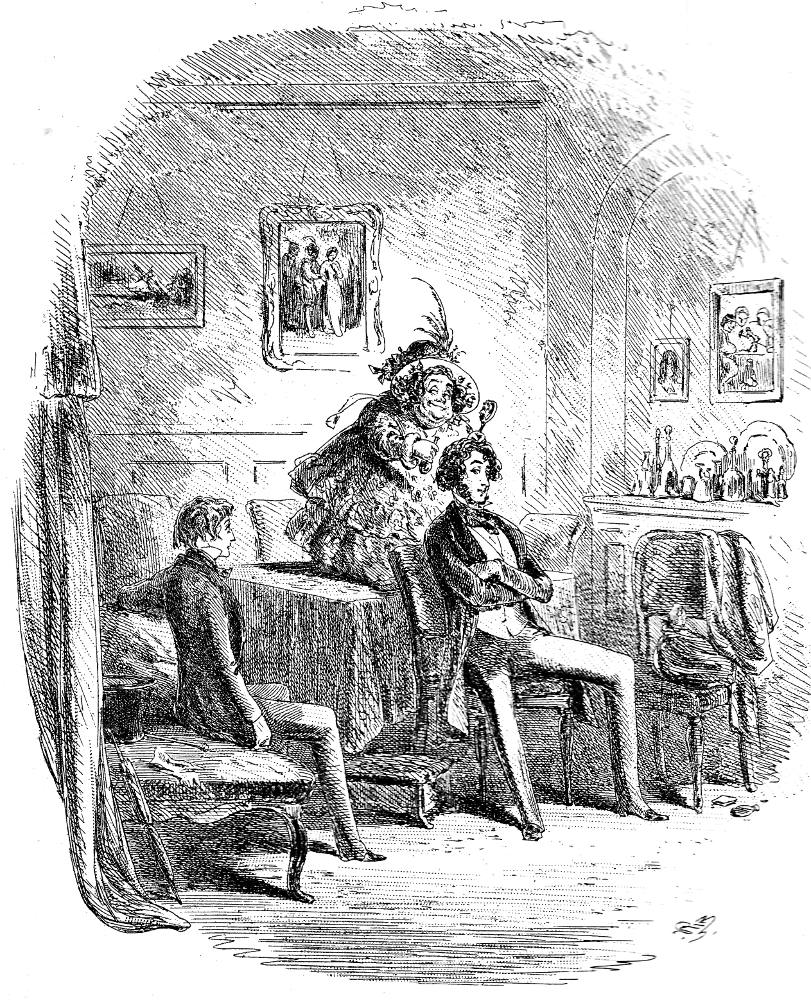
The name of Miss Mowcher was announced and, in anticipation
of her entrance, Mr Headstone looked at the doorway and saw nothing. He was
still looking at the doorway, thinking that Miss Mowcher was a long while
making her appearance, when, to his infinite astonishment, there came waddling across
the floor a diminutive female individual, of about forty or forty-five, with a
very large head and face and a pair of roguish grey eyes. Her chin, which was
what is called a double chin, was so fat that it entirely swallowed up the
strings of her bonnet, bow and all. Throat she had none; waist she had none;
legs she had none, worth mentioning; she was so short that she stood at a
common-sized chair as at a table, resting a bag she carried on the seat. From
this bag she extracted the instruments of her trade and arranged them before
her. She tilted some of the contents of a little blue bottle on to a piece of
flannel, and, again imparting some of the virtues of that liquid preparation to
a little brush, began rubbing and scraping at the offending bear’s grease with
both until it had quite dissolved. Then with a wink and a flourish and - with a
sound like that of the weasel - the lady removed Mr Headstone’s hat from his
head and tossed it into the air. The fee for this service was five shillings,
which Mr Headstone willingly paid. Miss Mowcher tossed up his two half-crowns
like a goblin pieman, caught them, dropped them in her pocket, and gave it a
loud slap. Her work complete, the lady turned about and waddled off in search
of refreshment, followed by the admiring gaze of Mr Poll Sweedlepipe, Miss Mowcher being in his eyes the nonpareil of their
trade.
Tuesday, February 12, 2013
In Which The Game Chicken Once Again Admits Defeat
If Mr. Headstone had never given any previous thought to the
adhesive properties of frozen bear’s grease, he had good reason to entertain
some consideration of the topic when he arrived at The George and Vulture and discovered that his hat could no longer
be detached from his head. The pedagogue appealed to the Game Chicken for
assistance, he being of all the assembled company the brawniest individual, and
a space was cleared to allow that gentleman room to do his work. Despite the
application of all his strength, combined with a strict observation of
Archimedean principles, the Chicken was neither able to pry, nor to wrench, nor
to twist that stubborn article from the schoolmaster’s head. Although these
endeavours met with no success, the spectacle served to provide some
entertainment for the guests, who applauded the performance under the
mistaken belief that they were witnessing one of the tableaux vivants advertised in the programme. Mr Poll Sweedlepipe
took a particular interest in the scene, and when the Chicken had finally
thrown in the towel, the barber suggested that where brute strength had failed,
feminine wiles might prevail. In short, he proposed that Miss Mowcher be
summoned at once.
Thursday, February 7, 2013
Containing Tonsorial Advice
Mr. Headstone is in the midst of his preparations for the
evening’s celebration at The George and
Vulture. He has put on his best clothes and has cleaned his boots over and
over again. He has ornamented his waistcoat with a gold watch and chain, put a
ring upon his little finger, and wears his newest silk neckerchief about his
throat. He is at this precise moment standing in front of a looking glass,
admiring the effect of these decorative touches upon his person whilst applying
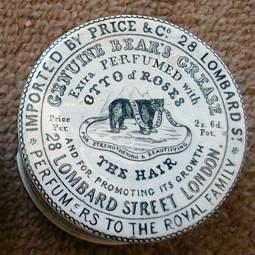
a liberal quantity of bear’s grease to his scalp. The pedagogue has taken to
using this compound on the tonsorial advice of Mr. Poll Sweedlepipe, who recently
received delivery of one hundred china pots of the aforementioned ursine fat from the Americas, and
is eager to turn a profit on them.
Mr. Headstone worries that he has been
somewhat too liberal in his application of the grease, but his attempts to
wring out the excess have no effect other than to cause him some discomfort and
to produce in his appearance something of the fera naturae. Resignedly, he buttons up his great coat – for it is
snowing hard outside – and, as a precaution against the wind, pulls his hat firmly
down upon his crown until the fat oozes out from under the brim. The odour he trails behind him as he descends the stairs is
strong enough to startle his landlady’s cat, which spits and hisses as he
passes, and the pedagogue must put his faith in the cold night air to disperse the
musky olfactory properties of the compound as he makes his way through the
streets.
Tuesday, February 5, 2013
Further Proceedings Of The Society
The meeting of the Society was called to order by Mr.
Swiveller, who, after some appropriate remarks, offered the following
resolution, which was unanimously adopted:
Resolved: That to add
a strikingly novel and agreeable feature to the intended anniversary dinner,
and in compliance with the desire universally expressed, it was suggested that
a number of Tableaux Vivants be performed,
drawn from the novels of Mr.Dickens and shadowing forth in living pictures, the
graphic and glowing delineations of this singularly gifted and original author.
On motion, it was resolved, that the Chairman appoint Mr. Crummles to carry the
foregoing arrangements into effect. Mr Crummles accepted the commission on the
understanding that the performance of the aforesaid tableaux would be a limited
engagement of one night only.
Monday, February 4, 2013
In Which The Members Of The Society Are Thrown Into A Quandary
As Mr Snodgrass had anticipated, the letter of invitation
composed by Mr Headstone was met with a rapturous reception when it was read
out by its author at the next meeting of the society. Having attained universal
approbation for his work, the pedagogue had now only to append an address to
the envelope to complete his task, but – as on so many other occasions - he seemed
destined to be thwarted at the last. In short, no member of those gathered in
the upper room at The George and Vulture
could come to any agreement as to where the letter should be sent. Mr Snodgrass
was of the firm opinion that Mr Dickens resided in Doughty Street. Mr Toots and the Game
Chicken disputed this claim and were of the view that the celebrated author’s
domicile was in Devonshire Terrace. Indeed, so convinced of this fact was the
Chicken that he at once proposed going five rounds with Mr Snodgrass to settle
the dispute, an invitation which the latter gentleman declined by taking refuge
behind a chair. A debate on the question was tabled, and, the motion being
carried, a lively discussion ensued; which was further enlivened by the introduction
of several more suggested destinations – both at home and abroad – from the
floor. When the matter was put to the vote, the house remained divided, and so
it was proposed that invitations be sent to each and every address in the hope
that one would find itself into the hands of the intended recipient. Having
received assurances from Mr Micawber that the society’s pecuniary resources
could meet the expense of the Penny Post, Mr Headstone approved the proposal,
and the society moved on to other business of the day.
Sunday, January 27, 2013
In Which Mr Headstone Composes An Invitation and Mr Snodgrass Gives His Opinion Of The Same
It being the express wish of all members of the Charles
Dickens Anniversary Society (CDAS) that a celebration dinner be held on the
seventh of February at The George and
Vulture, it fell upon Mr Headstone, as General Chairman of said society, to
compose a letter of invitation to the author. And so the pedagogue sat at his
writing desk, seeking inspiration by chewing on the end of his pen and staring
into the yellow eyes of the stuffed owl that he was wont to set before him as a
promoter of sagacity whenever he embarked on a literary venture. Desirous of
composing a missive worthy of its recipient, Mr Headstone expended voluminous
quantities of ink and paper on his endeavour, and consumed half a dozen hot
buttered crumpets by way of sustenance.
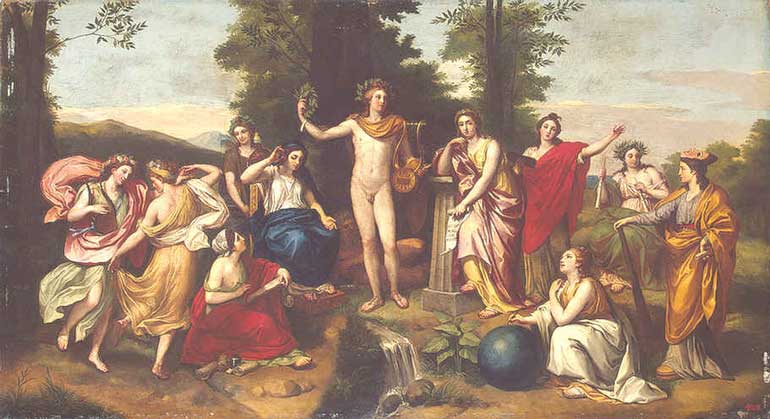
After some several hours of toil upon the lower slopes of Parnassus, the pedagogue had completed the task to his
satisfaction, and asked Mr Snodgrass, who had conveniently chosen to call at
that very moment, to give his opinion of it. That gentleman was still
recovering from the shock he had received when Mr Headstone, on opening the
door in response to his double knock, had presented a visage which appeared to
exhibit the advanced stages of a mortifying disease. Having been assured by the
pedagogue that the blueness of his lips was the result of nothing more serious
than a leaky pen, Mr Snodgrass had taken a chair by the fire and fortified
himself with a glass of Old Tom, and it was from this position that he now
perused Mr Headstone’s letter. His opinion was that as an example of its kind
it could – with the possible exception of spelling and punctuation – hardly be improved upon; that the style was
neither too florid – a common fault of novice authors – nor too pedestrian;
that it observed the strictures of the form by stating the time and the place
of the engagement without any unnecessary encumbrance; that its brevity would
surely be appreciated by a man of affairs; and that, in short, it should be put
before the members of the society for their delectation and approval at the
earliest possible opportunity.
Sunday, January 20, 2013
Containing The Transactions Of The Inaugural Meeting Of The Aforementioned Society
The reader who desires to know something of the origins of
the celebrated society established to mark the two hundredth and first anniversary
of the birth of the inimitable author Mr. Charles Dickens Esq. will derive no
small degree of satisfaction from a perusal of the following entry in the
transactions of the aforementioned association; this being a true and faithful
account of the proceedings of the inaugural meeting of the same.
‘January 20. Mr. Richard Swiveller, Esq., P.V.P.M.C.D.A.S*,
presiding. The following resolutions unanimously agreed to:-
‘That Mr. Bradley Headstone, Esq. is duly elected to the
honorable position of General Chairman of the Society and may forthwith append
the letters G.C.M.C.D.A.S † to his name on all correspondence relating to the
business of the Society.
‘That the said Bradley Headstone Esq. hereby undertakes to complete
his great project and to read within the space of a single calendar year the
following remaining works of Mr. Charles Dickens Esq.:
David Copperfield
Bleak House
Hard Times
Little Dorrit
A Tale of Two Cities
Great Expectations
Our Mutual Friend
The Mystery of Edwin
Drood
‘That the Society is deeply sensible of the advantages which
must accrue to the cause of literature from the completion of the aforesaid
project, and cannot but entertain a lively sense of the inestimable benefits
which must inevitably result from the observations of that learned gentleman,
to the advancement of knowledge, and the diffusion of learning.
‘That Mr. Augustus Snodgrass, Esq., M.C.D.A.S is duly
appointed as the Society’s official historian and shall record for posterity in prose sublime the transactions
of the Society, all of which shall be published for the general benefit of mankind.
Furthermore, the said Augustus Snodgrass Esq. shall on occasion compose such
verses as may be required by the Society for the proper execution of its celebratory
proceedings.
‘That Mr. Wilkins Micawber, Esq., M.C.D.A.S is duly
appointed as the Society’s Treasurer and shall be responsible for all pecuniary
matters relating to the Society’s transactions.
‘That the Society hereby deplores the paucity of national
events planned to commemorate the two hundredth and first anniversary of the
birth of the inimitable author Mr. Charles Dickens Esq. and shall petition
parliament on this burning question.
‘That the first act of the Society shall be to hold a public
dinner on the seventh of February at the establishment known as The George and Vulture to celebrate the
birth of Mr. Dickens, and that the author himself shall be invited to attend as
guest of honour. Furthermore, it is the fervent hope of the Society that the literary
gentleman can be prevailed upon to deliver a speech, or perhaps a song.’
* P.V.P.M.C.D.A.S – Perpetual Vice-President Member Charles
Dickens Anniversary Society
† G.C.M.C.D.A.S – General Chairman Member Charles Dickens
Anniversary Society
Subscribe to:
Comments (Atom)