The land around the town of Mr Headstone's birth - which we will call Avondale, though that is not its true name - was once planted with a profusion of sturdy English oak trees. In days of yore it was the favourite hunting ground of the king, and so it had bestowed upon it the noble title of forest - thereby conveniently granting the monarch the sole rights of possession to all the produce of the land. No doubt this royal prerogative would have remained until this day had not subsequent royal personages found themselves in need of funds to swell the royal coffers; these coffers being much depleted by royal notions of extravagance that required a steady supply of ermine gowns, golden sceptres and satin cushions, which were then believed (and perhaps still are) to be the everyday necessities of a royal existence. And so, piece by piece, acre by acre, the forest was sold to enterprising gentleman, who, tree by tree, acre by acre, cut it down for the purposes of husbandry.
Had Mr Headstone paused to view the much changed landscape on the Sunday morning he set out in the direction of a neighbouring village for The Red Lion, he might have had occasion to mourn its passing and consider how transient is the existence of man. However, it can be reported with a degree of both conviction and confidence that no legal mind could hope to challenge even in the highest court of the land, that no such melancholy reflections crossed the schoolmaster's mind. Indeed, as he followed the winding footpath through a coppice of elm and ash, his thoughts were centered not in that seat of learning but, lower down, in the region of his stomach, which, being empty (like his mind) was inclined to promote concentration on one subject alone - that being the prospect of a hearty meal.
The Red Lion was a house of public entertainment, or what ordinary people would designate a public house; which fact was demonstrated to all travellers as could neither read nor write by an emblem of that noble crimson creature suspended above the doorway. In common with many such establishments, the landlord of this tavern had elected to name it after a beast never before seen in nature in that particular hue as if a more commonplace association of colour and quadruped - such as The Brown Horse, or The Piebald Cow - would have a less efficacious effect on attracting passing trade.
This particular 'pub' - to give it the common name - was renowned the country round for its hearty English vitals, and Mr Headstone had tramped five miles to work up an appetite that would be equal to its epicurean reputation. When presented with the bill of fare, the schoolmaster was thrown into the immediate quandary that will be familiar to any discriminating gourmand. Should he plump for the roast duck, or the side of beef, or the saddle of lamb? Would it be an extravagance to order all three? After much indecision and procrastination - as dangerous in company as tow and flame - Mr Headstone decided upon the duck. The waiter congratulated him on his choice of repast and, bowing obsequiously, backed away from the table, narrowly avoiding an entanglement with a small dog that seemed to have the run of the floor.
No sooner had the waiter retired with the order than the pedagogue recalled that the meat of a duck was inclined to be fatty, and, in a voice more modulated for the acoustical dimensions of a ship maker's yard than the interior of a small public house, revoked his claim on the fowl. The waiter - still bobbing like a cork on water - took up his post at the table and waited with divine patience as Mr Headstone ruminated, an operation which appeared to require the repetition of the entire bill of fare in a low voice as if it were a kind of catechism. He decided upon the beef. The waiter congratulated him again and retired, one eye of his bobbing head keeping a look-out for the vivacious pup.
As soon as the waiter had left his side, Mr Headstone was racked with doubt. What if the beef were underdone? Or overdone? It would not do. No sailor atop the highest mast of a stricken barque could on sighting land have raised his voice to that pitch of excitement with which the pedagogue denounced the beef. The waiter returned, and, after the manner of his calling, waited. Mr Headstone decided on the lamb. He was congratulated on his choice and furthermore commended not to subject it to any further variation.
When the groaning platter was brought to the table, piled high with slabs of meat, green beans and steaming roast potatoes, Mr Headstone wasted no time in affixing a white napkin under his chin. Setting his arms akimbo in a position appropriate to the action of doing full justice to his repast, he pierced the largest roast potato with his fork and stuffed it whole into his mouth. This manner of proceeding was entirely natural for a hungry man and would have occasioned no reason for comment had it not been for the temperature of the aforesaid vegetable. A common appreciation of the physical laws that govern the universe tells us that any solid object that attains a significant temperature is likely to be hotter on the inside than the outside. Certain it was that, had Mr Headstone been ignorant of this common piece of knowledge beforehand, he was quickly apprised of its veracity at the moment he began to chew. It was fortunate that the waiter had placed at his elbow a jug of liquid and with this he sought to quench the burning sensation in his throat. It was, however, unfortunate that the liquid in question was a pint of mint sauce, made with the principal compound of malt vinegar.
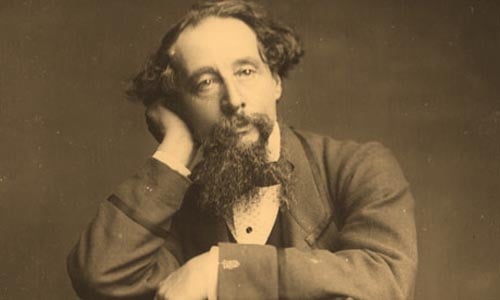
Mr Charles Dickens