In an attempt to whet Mr Headstone's appetite for a private and most particular tour of the Roman fort, Mr Sikes was eager to promote that edifice in the pedagogue's opinion as a marvel of classical architecture, and, as he led him up a dark and twisting hill path on the outskirts of the town, he compared it in favourable terms to such mighty constructions as the Ancient Pyramids and the Hanging Gardens of Babylon. As Mr Headstone had never had the occasion to view the aforementioned wonders, Mr Sikes's effusive recommendations did not materially add to the impression the former gentleman had already formed in his own mind as to the likely prospect that awaited him - an impression which was based on his somewhat limited experience of visiting some of the country's most famous ancient or ruined monuments.
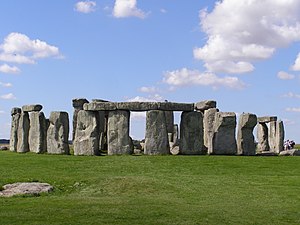
The schoolmaster remembered being severely disappointed on the first occasion he had seen Stonehenge and he further recalled that at the time he had expressed himself of the opinion that it was considerably draughtier than a place of worship had any right to be. An excursion to Hadrian's Wall (a construction designed to keep an entire race of blue-faced individuals out of the country) had been marred by an accident in which he had caused a portion of the stonework to collapse simply by leaning against it in a moment of repose - an action, which he claimed when he represented himself to the local magistrate, any man might expect a structure worthy of the name of wall to be able to support.
Mr Headstone was recalled from these reveries by a series of animated whispers from Mr Sikes, which were indicative of the fact that they had arrived at the summit on which the ruins stood. Authors of romantic verse know that there is something in the quality of moonlight that lends a grandeur and a glory to even the most commonplace surroundings, but even the poet Ovid - had he stood atop that hill shoulder to shoulder with Mr Headstone and Mr Sikes - would have had difficulty in distinguishing any salient feature of the landscape under the threatening rain clouds. To recover from the mutual dissatisfaction of not being able to see anything, Mr Sikes proposed that they investigate the ancient well, which, he said, was a fascinating early example of Roman aquatic management. Mr Headstone, whose interest in that very topic was indeed very acute, instructed his guide only to lead and he would follow.
They came to a large hole in the ground surrounded by a broken circle of stones, and Mr Sikes, desirous of providing his client with the very best possible service, suggested that if Mr Headstone wished to lean forward to inspect the interior of the well more closely he would gladly stand behind him to prevent any unfortunate occurence that the loose soil around the edge might occasion. Mr Headstone was extremely obliged to Mr Sikes for his trouble, and was on the point of taking up such a position when a tremulous cry from behind a nearby column rooted both men to the spot. The sound also attracted the attention of Bull's Eye, Mr Sikes's terrier, who had been following his master so silently and obediently that his presence had up until this moment escaped our attention. The animal flattened his ears and growled, and Mr Sikes, who seemed capable of discerning some intelligence in the canine's actions, called his dog to heel, and without any further ceremony disappeared into the night.
Mr Headstone was too astonished by his guide's behaviour to do anything other than quake in his boots. Ruins were known to be favoured by ghosts, on account, the pedagogue supposed, of the familiarity of their furnishings. Had they unwittingly disturbed one of the spirits of the place? Perhaps it was a headless Roman centurion, condemned to walk the earth between the hours of sunset and sunrise. Another cry from behind the pillar dispossessed Mr Headstone of this assumption for, as he reasoned with himself, anyone without a head would have difficulty in any form of vocal articulation. The schoolmaster was considering whether or not he should imitate the example of his guide and fly the scene when a figure stepped out from behind the column. At that same moment a rent in the cloudy heavens permitted the beams of the full moon to fall upon the spot and revealed the figure to be none other than that of Mr Augustus Snodgrass, whose presence will be explained in our following communication.
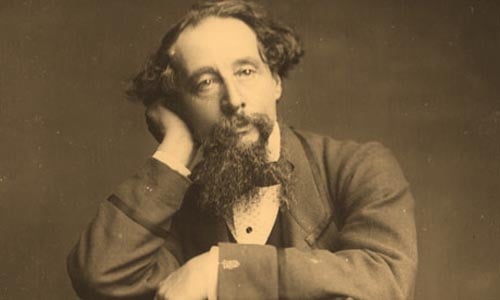
Mr Charles Dickens