Having returned to his lodgings from a visit to Newgate, Mr Headstone was most desirous to pick up the threads of his old life, and, with this object in mind, he ordered in a dozen crumpets and settled himself in close proximity to a blazing fire, the crimson coals of which performed the twin offices of warming his bones and toasting the aforementioned comestibles. His own particular comfort was made complete by the placement of a glass of generous port within easy reach on the round cedar coffee table, and, with the bottle safely stowed on the chimney-piece in case it was wanted, the pedagogue opened Oliver Twist to the page at which he had been obliged to leave off by the inconvenient intervention of the law.
The month of February - having (like a condemned man) been granted a day's reprieve - was almost at its end, and Mr Headstone, conscious of having fallen behind in his great project, read with as much speed and concentration as the warmth of the fire, the heat of the alcohol, and his appetite for crumpets would allow. Having finished the book as the shades of evening were drawing in, he lit a candle and sat himself at his writing desk, and took up his pen to record some reflections of a literary nature.
Oliver Twist; or, the Parish Boy's Progress was Mr Dickens's second novel, and it was begun by the author before he had even completed his first. Mr Headstone could not quite approve of this way of working as he himself was never a man to take up a new task when an old one still remained undone - a convenient philosophy which allowed him to regulate his labours according to his own desires. Coming from the pen of 'Boz', the creator of the Pickwick craze, the story of the orphan boy was received with enthusiasm by the reading public although - as the author himself observed - it was also objected to on some high moral grounds in some high moral quarters. The depiction of the associates in crime in all the squalid misery of their lives was necessary to point out the principle of good surviving through every adverse circumstance; and if the diet of wretchedness was too severe to be taken at once, then there were several courses of comic intervention to soothe the palate. As Mr Dickens himself phrased it at the beginning of Chapter Seventeen, "it is the custom [...] in all good murderous melodrama to present the tragic and the comic scenes, in as regular alternation, as the layers of red and white in a side of streaky bacon." Recalling this figure of speech, Mr Headstone, who approved of all forms of pork meat (fried, broiled, or roasted), wondered whether it would not be an appropriate occasion for ordering in something from the German-sausage shop round the corner, particularly as he had just appended the last crumpet to his toasting fork.
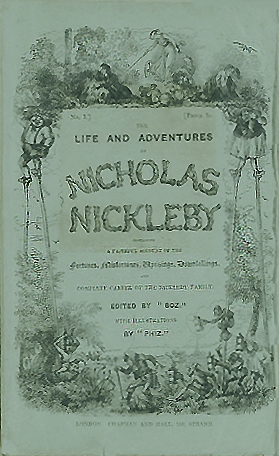
The pedagogue returned Oliver Twist to the shelf, reflecting as he did so that had he been apprised of the true character of Bill Sikes, he would never have suffered the gentleman's acquaintance, and so might have avoided that portion of misfortune which had so recently been allotted to him. He took down The Life and Adventures of Nicholas Nickleby, a volume about twice the length of the book he had just completed. Feeling in immediate need of sustenance, the pedagogue put his head out of the window and called down to the butcher's boy.
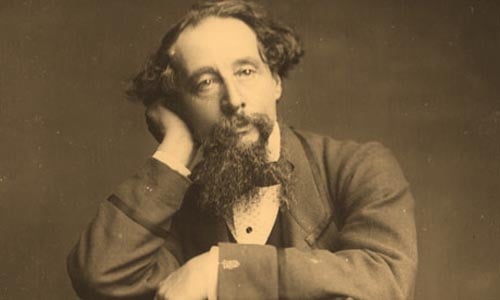
Mr Charles Dickens
Wednesday, February 29, 2012
Monday, February 27, 2012
In Which Mr Headstone Finds Refuge In the Spirit
Having gained his liberty from one of the country's most notorious gaols thanks to the tireless endeavours of the selfless Mr Brownlow, Mr Headstone regrettably found that he was unable to extricate himself from that gentleman's company with as much ease. He suffered the elderly samaritan to accompany him down the steps, across the courtyard, through the great iron door that was closed to so many, out onto the bustling pavement, and into the tumult of the great city. All the while Mr Brownlow regaled his companion with a repetition of his account of the circumstances that had brought him to that place, either in the mistaken assumption that the pedagogue would be pleased to hear the lengthy narrative from its beginning to its end once again, or from a misapprehension not uncommon in an elderly person that he was recounting the story for the first time.
The prison from which Mr Headstone had just been released was in the region of Snow Hill, which, by a remarkable and fortuituous coincidence, was also the very ground upon which stood that place of sanctuary commonly known as The Saracen's Head. His pockets being empty and the chalk marks against his name behind the bar being many, Mr Headstone resolved to further endure the company of his kind redeemer on the expectation that he would be willing to once again demonstrate his charitable nature by paying the reckoning. The pedagogue intimated to Mr Brownlow his desire to seek spiritual refuge in a nearby site of contemplation, and, directing his gaze meaningfully towards the spire of St Sepulchre's, led the pious gentleman along Skinner Street until they arrived at number forty nine.
Mr Brownlow expressed some surprise at finding himself outside a tavern, and evinced a strong disinclination to enter the bar until Mr Headstone had gathered some other members of the faith from within to persuade that worthy of their strong desire to celebrate his benevolence and his charity, expressing a most particular interest in the latter. Mr Brownlow's apotheosis was rapidly achieved by the passing round of some brandy and water and by the singing of songs, which, though not to be found in any hymnal, were pretty well known by the entire congregation.
The prison from which Mr Headstone had just been released was in the region of Snow Hill, which, by a remarkable and fortuituous coincidence, was also the very ground upon which stood that place of sanctuary commonly known as The Saracen's Head. His pockets being empty and the chalk marks against his name behind the bar being many, Mr Headstone resolved to further endure the company of his kind redeemer on the expectation that he would be willing to once again demonstrate his charitable nature by paying the reckoning. The pedagogue intimated to Mr Brownlow his desire to seek spiritual refuge in a nearby site of contemplation, and, directing his gaze meaningfully towards the spire of St Sepulchre's, led the pious gentleman along Skinner Street until they arrived at number forty nine.


Mr Brownlow expressed some surprise at finding himself outside a tavern, and evinced a strong disinclination to enter the bar until Mr Headstone had gathered some other members of the faith from within to persuade that worthy of their strong desire to celebrate his benevolence and his charity, expressing a most particular interest in the latter. Mr Brownlow's apotheosis was rapidly achieved by the passing round of some brandy and water and by the singing of songs, which, though not to be found in any hymnal, were pretty well known by the entire congregation.

Saturday, February 25, 2012
In Which Mr Headstone Hears A Lengthy Account Of Another Man's Misfortune
Mr Headstone's surprise on being informed that a visitor awaited his attendance in the warden's office was compounded by the fact that, on entering this latter gentleman's billet, the pedagogue was ushered into the company of a very respectable-looking old personage. He was dressed in a bottle-green coat with a black velvet collar; wore white trousers; and carried a smart bamboo cane under his arm. As if these sartorial embellishments were not enough to distinguish him from his fellows, he also wore around his head a copious length of medical bandage. Seeing the expression of puzzlement that began to arrange itself around the features of Mr Headstone, this gentleman lost no time in introducing himself as Mr Brownlow and explaining that he was a resident of that same street in Pentonville where Mr Headstone had encountered the housebreaker Sikes.
Mr Brownlow had been returning to his own home on the evening in question when his meditations on the wondrous variety of creation - which had been occasioned by a contemplation of the constellations in the night sky - had been rudely interrupted by the no less wondrous spectacle of a human form interposing itself between his upturned gaze and the heavens, and travelling at a speed not incompatible with that attained by a projectile when discharged from a cannon. Mr Brownlow followed the trajectory of this object with an amateur astronomer's interest and noted where it fell; that place being the back of a a drayman's waggon, the benevolent gentleman ran forward in the desire to offer some assistance to the poor unfortunate. Catching up with the vehicle at the next crossing, this good Samaritan peered over the hind board to see the form of a roughly clothed bearded man lying on some empty hessian sacks in a state of semi-consciousness.
At that same instant Mr Brownlow became aware of a deep growling sound coming from behind him and he turned to see a red-eyed bull terrier standing in the road. With an athleticism quite unusual for such a short-legged stocky-framed creature, the dog leapt into the cart and succeeded in reviving the prostrate man by the liberal application of its thick coarse tongue to his face. For this service, the animal received no greater token of gratitude than a curse and a kick, and - when he attempted to intercede on the poor beast's behalf - Mr Brownlow received the same treatment at compound interest. The drayman, by now alerted to the fact that some form of altercation was taking place in the rear of his waggon, came round to see what the matter was. He quickly apprised himself of the situation and, seeing that the gentleman with the upper hand in the dispute was the owner of both a large cudgel and a vicious dog, wisely decided against any intervention and ran away. Sikes seized the opportunity and, relieving Mr Brownlow of his gold pocket watch and chain and other sundry items that he had about his person, tossed that unfortunate gentleman into the street, took up the reins of the cart and drove away in haste, the dog all the while standing with its forelegs on the hind board and barking hoarsely.
Any encounter that ends in a disagreement which can only be settled by recourse to physical means must always end to the disadvantage of one of the parties involved, and, in this instance, it was the good Samaritan who suffered the indignity and discomfort of a broken crown. Inspecting his injuries in the safety of his own home, Mr Brownlow found them to be less serious than the above description might have given cause to suggest, and, by the following morning, the gentleman was sufficiently recovered to go out after breakfast to report the incident at the nearest metropolitan police office, which was situated on Mutton Hill.
Here Mr Brownlow paused in the relation of his tale of misfortune to allow Mr Headstone an opportunity to anticipate the conclusion of the narrative, but, as the pedagogue gave no sign of doing so and simply stared him out of countenance with an expression of blank incredulity, the benevolent gentleman swiftly brought his story to its end: viz, that learning of Mr Headstone's circumstances from the arresting officer, Mr Brownlow became convinced that a great injustice had been done, and resolved there and then not to rest until the wrong had been righted; that in his pursuit of the truth, Mr Brownlow had enlisted the aid of his friend Mr Grimwig, who had sworn to eat his own head if the case was not overturned; that Mr Brownlow had also engaged two Bow Street officers to track down the nefarious Sikes; that these gentlemen had arrested several individuals answering to the wanted man's description, but, unfortunately, not answering to his name; that Mr Brownlow had offered from his own purse a reward of fifty pounds for any information leading to the apprehension of the villain; that the rogue had been spotted, pursued and cornered in a deserted house on Jacob's Island, and that in a desperate attempt to elude his pursuers across the rooftops he had lost his footing and fallen to his death, followed by his faithful dog. Sikes was no more and in his last desperate hour he had confessed his role in the attempted robbery in Pentonville. Mr Headstone's name was no longer sullied with suspicion, and the pedagogue was from that moment a free man.
Mr Brownlow had been returning to his own home on the evening in question when his meditations on the wondrous variety of creation - which had been occasioned by a contemplation of the constellations in the night sky - had been rudely interrupted by the no less wondrous spectacle of a human form interposing itself between his upturned gaze and the heavens, and travelling at a speed not incompatible with that attained by a projectile when discharged from a cannon. Mr Brownlow followed the trajectory of this object with an amateur astronomer's interest and noted where it fell; that place being the back of a a drayman's waggon, the benevolent gentleman ran forward in the desire to offer some assistance to the poor unfortunate. Catching up with the vehicle at the next crossing, this good Samaritan peered over the hind board to see the form of a roughly clothed bearded man lying on some empty hessian sacks in a state of semi-consciousness.
At that same instant Mr Brownlow became aware of a deep growling sound coming from behind him and he turned to see a red-eyed bull terrier standing in the road. With an athleticism quite unusual for such a short-legged stocky-framed creature, the dog leapt into the cart and succeeded in reviving the prostrate man by the liberal application of its thick coarse tongue to his face. For this service, the animal received no greater token of gratitude than a curse and a kick, and - when he attempted to intercede on the poor beast's behalf - Mr Brownlow received the same treatment at compound interest. The drayman, by now alerted to the fact that some form of altercation was taking place in the rear of his waggon, came round to see what the matter was. He quickly apprised himself of the situation and, seeing that the gentleman with the upper hand in the dispute was the owner of both a large cudgel and a vicious dog, wisely decided against any intervention and ran away. Sikes seized the opportunity and, relieving Mr Brownlow of his gold pocket watch and chain and other sundry items that he had about his person, tossed that unfortunate gentleman into the street, took up the reins of the cart and drove away in haste, the dog all the while standing with its forelegs on the hind board and barking hoarsely.
Any encounter that ends in a disagreement which can only be settled by recourse to physical means must always end to the disadvantage of one of the parties involved, and, in this instance, it was the good Samaritan who suffered the indignity and discomfort of a broken crown. Inspecting his injuries in the safety of his own home, Mr Brownlow found them to be less serious than the above description might have given cause to suggest, and, by the following morning, the gentleman was sufficiently recovered to go out after breakfast to report the incident at the nearest metropolitan police office, which was situated on Mutton Hill.
Here Mr Brownlow paused in the relation of his tale of misfortune to allow Mr Headstone an opportunity to anticipate the conclusion of the narrative, but, as the pedagogue gave no sign of doing so and simply stared him out of countenance with an expression of blank incredulity, the benevolent gentleman swiftly brought his story to its end: viz, that learning of Mr Headstone's circumstances from the arresting officer, Mr Brownlow became convinced that a great injustice had been done, and resolved there and then not to rest until the wrong had been righted; that in his pursuit of the truth, Mr Brownlow had enlisted the aid of his friend Mr Grimwig, who had sworn to eat his own head if the case was not overturned; that Mr Brownlow had also engaged two Bow Street officers to track down the nefarious Sikes; that these gentlemen had arrested several individuals answering to the wanted man's description, but, unfortunately, not answering to his name; that Mr Brownlow had offered from his own purse a reward of fifty pounds for any information leading to the apprehension of the villain; that the rogue had been spotted, pursued and cornered in a deserted house on Jacob's Island, and that in a desperate attempt to elude his pursuers across the rooftops he had lost his footing and fallen to his death, followed by his faithful dog. Sikes was no more and in his last desperate hour he had confessed his role in the attempted robbery in Pentonville. Mr Headstone's name was no longer sullied with suspicion, and the pedagogue was from that moment a free man.
Wednesday, February 22, 2012
In Which Mr Headstone Receives An Unexpected Visitor
Being no stranger to misfortune, Mr Headstone had every reason to believe that - notwithstanding his innocence of the crime with which he had been charged - his sojourn within the walls of Newgate Prison was likely to be a lengthy one. Indeed, it was a remarkable feature of the place that every individual was incarcerated under similar conditions of misunderstanding, and that if only these irregularities could be corrected by the proper application of the instruments of law then the entire population would be set at liberty at once.
The number of cells within the prison never being equal to the numbers of inmates wishing to occupy them, Mr Headstone was obliged to share his accommodation with two other gentleman, one of whom had been falsely charged with poisoning his wife on the expectation of coming into her fortune upon her decease; the other being in the unfortunate position of having a countenance that was the exact likeness of a notorious horse thief, who had lately been observed in the execution of his trade by three independent witnesses. Mr Headstone had been languishing in his room for several days, occasionally engaging with these two worthies in conversation of a most instructive nature, when a message came for him to report to the warden's office, where a visitor awaited him. No doubt the reader is eager to learn - as the pedagogue was - the identity of this individual and his purpose, and it is regrettable that this curiosity must remain unsatisfied until our next communication.
The number of cells within the prison never being equal to the numbers of inmates wishing to occupy them, Mr Headstone was obliged to share his accommodation with two other gentleman, one of whom had been falsely charged with poisoning his wife on the expectation of coming into her fortune upon her decease; the other being in the unfortunate position of having a countenance that was the exact likeness of a notorious horse thief, who had lately been observed in the execution of his trade by three independent witnesses. Mr Headstone had been languishing in his room for several days, occasionally engaging with these two worthies in conversation of a most instructive nature, when a message came for him to report to the warden's office, where a visitor awaited him. No doubt the reader is eager to learn - as the pedagogue was - the identity of this individual and his purpose, and it is regrettable that this curiosity must remain unsatisfied until our next communication.
Tuesday, February 21, 2012
In Which Mr Headstone Is Introduced To A New Society
Having being charged with a felony, Mr Headstone was considered too desperate a villain to be kept within the modest confines of the metropolitan police station at Mutton Hill. It being the professional opinion of the magistrate, the arresting officer, the jailer and the obstreperous cook that only the walls of Newgate could contain such a specimen of human knavery, arrangements were made to convey the pedagogue to that noble institution, where, by commingling with others of his kind, he would either learn the error of his ways, or become more intimately acquainted with the tricks of his chosen trade.
A horse drawn van was procured for the purpose and Mr Headstone was obligingly accommodated on the inside without the necessity of having to pay a fare. This mode of transportation was similar to a hackney carriage in every feature but one; this being the addition of iron bars to the windows, and that not for any decorative purpose. It was a pale and forlorn face that peered through these palings of captivity at the crowded street on which the stone ramparts of Newgate prison frowned so darkly. As the van passed through the stone arch and the great iron portcullis closed behind him, Mr Headstone surveyed his new surroundings and its occupants with a cautious eye.
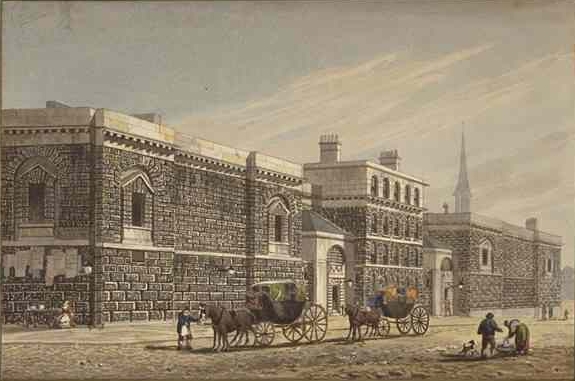
A horse drawn van was procured for the purpose and Mr Headstone was obligingly accommodated on the inside without the necessity of having to pay a fare. This mode of transportation was similar to a hackney carriage in every feature but one; this being the addition of iron bars to the windows, and that not for any decorative purpose. It was a pale and forlorn face that peered through these palings of captivity at the crowded street on which the stone ramparts of Newgate prison frowned so darkly. As the van passed through the stone arch and the great iron portcullis closed behind him, Mr Headstone surveyed his new surroundings and its occupants with a cautious eye.
Monday, February 20, 2012
In Which Mr Headstone Appears Before A Magistrate
In keeping with the custom of other establishments of public accommodation, the metropolitan police station at Mutton Hill was pleased to offer its guests a complimentary breakfast as part of its service of hospitality. This meal, which consisted of a bowl of thin gruel and a raw onion, was administered by an obstreperous cook on the admirably democratic basis of "first come, first served"; and, as the quantity of victuals was never equal to the number of mouths to be fed, it was invariably the case that some had their fill and some went without - a state of affairs which any parliamentary reporter will observe is, indeed, a common feature of democracies.
Mr Headstone, being unfamiliar with the customs of the place, was disappointed to be given a very shallow serving of gruel in a greasy bowl and was further surprised that, when he asked for more, the cook aimed a blow at his head with the ladle and shrieked aloud for the jailer. Receiving the blow on that same spot favoured by Mr Sikes's crowbar, the pedagogue found that the condition of his mental faculties did not improve withal, and that the application of another metal object to the exterior of his skull was a retrograde step in his convalescence.
Answering the cook's summons, the jailer appeared, and, taking Mr Headstone roughly by the collar, marched him out of the cell, up the stairs and into the magistrate's office - this method of locomotion being much favoured by representatives of the law. The office was a front parlour, with a panelled wall, and, at the upper end of it behind a bar sat the imposing figure of Mr Fang, a lean, long-backed, stiff-necked, middle-sized gentleman with a stern and much flushed face. Having taken up a position in a wooden pen opposite the bench, Mr Headstone was sworn in, and asked by the magistrate to give an account of himself and his actions of the night before, which the pedagogue did; and the account being a true representation of the events previously described, it will not surprise the reader to learn that Mr Fang charged the unfortunate school master with attempted housebreaking, and committed him to three months of hard labour.
Mr Headstone, being unfamiliar with the customs of the place, was disappointed to be given a very shallow serving of gruel in a greasy bowl and was further surprised that, when he asked for more, the cook aimed a blow at his head with the ladle and shrieked aloud for the jailer. Receiving the blow on that same spot favoured by Mr Sikes's crowbar, the pedagogue found that the condition of his mental faculties did not improve withal, and that the application of another metal object to the exterior of his skull was a retrograde step in his convalescence.
Answering the cook's summons, the jailer appeared, and, taking Mr Headstone roughly by the collar, marched him out of the cell, up the stairs and into the magistrate's office - this method of locomotion being much favoured by representatives of the law. The office was a front parlour, with a panelled wall, and, at the upper end of it behind a bar sat the imposing figure of Mr Fang, a lean, long-backed, stiff-necked, middle-sized gentleman with a stern and much flushed face. Having taken up a position in a wooden pen opposite the bench, Mr Headstone was sworn in, and asked by the magistrate to give an account of himself and his actions of the night before, which the pedagogue did; and the account being a true representation of the events previously described, it will not surprise the reader to learn that Mr Fang charged the unfortunate school master with attempted housebreaking, and committed him to three months of hard labour.
Sunday, February 19, 2012
In Which Mr Headstone Attracts Some Attention
Mr Headstone, who was still suffering from the blow to the head he had received from the displaced contents of the carpet bag, was lugged along the streets by the jacket collar, at a rapid pace, which was not entirely conducive to his comfort or his well-being. Despite his protestations to the officer of the law, who provided the locomotive force for the two of them, the situation was in no manner ameliorated until they came within sight of a very notorious metropolitan police station near Mutton Hill. By this time a crowd of onlookers, attracted by the spectacle of the pedagogue being propelled through the streets against his own inclinations, had formed a veritable procession about them. Some of them ran behind, jeering and shouting, whilst others went before them, calling to other idlers lolling in the doorways of taverns to join the parade, which, lacking any other form of useful employment, they willingly did. Each member of the mob being desirous of discovering the cause of the arrest, there was a great exchange of views and opinions on the matter, all of which were compensated in terms of imagination for what they lacked in veracity.
Some whispered that the villain had robbed an old lady of her reticule, others that he had stolen six silver spoons from a grieving widow, or that he had made away with the plate from a house on Muswell Hill; that he had bludgeoned a woman to death with a cudgel; that he had run through a prominent member of the aristocracy with a sword to settle a matter of honour; that he had sold adulterated elixirs to the sick; that he had stolen coppers from the poor box; that he had cheated at cards; that he had robbed a grave and sold its contents to a medical man; that he had set fire to a rick, and smashed a threshing machine; & co, & co. In fact, had the crowd been given the satisfaction of accompanying Mr Headstone and his guardian through any more streets, it is likely that the former gentleman would have been publicly accused of every criminal act then extant on the statute books.
At last the officer and his charge were able to disengage themselves from the mob, and, passing beneath a low archway and up a dirty court, they entered the dispensary of summary justice by the back way. It was a small paved yard into which they turned; and here they encountered a stout man with a bunch of whiskers on his face, and a bunch of keys in his hand. This fellow, being eager to extend all the courtesies of hospitality to his guest, led Mr Headstone down a flight of steps and into a stone cell. Here the pedagogue was obliged to turn out his pockets, and these being, as they usually were, empty, Mr Headstone was allowed to make himself as comfortable as he could on the stone flags and wait until morning.
Some whispered that the villain had robbed an old lady of her reticule, others that he had stolen six silver spoons from a grieving widow, or that he had made away with the plate from a house on Muswell Hill; that he had bludgeoned a woman to death with a cudgel; that he had run through a prominent member of the aristocracy with a sword to settle a matter of honour; that he had sold adulterated elixirs to the sick; that he had stolen coppers from the poor box; that he had cheated at cards; that he had robbed a grave and sold its contents to a medical man; that he had set fire to a rick, and smashed a threshing machine; & co, & co. In fact, had the crowd been given the satisfaction of accompanying Mr Headstone and his guardian through any more streets, it is likely that the former gentleman would have been publicly accused of every criminal act then extant on the statute books.
At last the officer and his charge were able to disengage themselves from the mob, and, passing beneath a low archway and up a dirty court, they entered the dispensary of summary justice by the back way. It was a small paved yard into which they turned; and here they encountered a stout man with a bunch of whiskers on his face, and a bunch of keys in his hand. This fellow, being eager to extend all the courtesies of hospitality to his guest, led Mr Headstone down a flight of steps and into a stone cell. Here the pedagogue was obliged to turn out his pockets, and these being, as they usually were, empty, Mr Headstone was allowed to make himself as comfortable as he could on the stone flags and wait until morning.
Saturday, February 18, 2012
In Which Mr Headstone Renews An Acquaintance To His Detriment
The series of unfortunate events which conspired to deprive society of Mr Headstone's company began late on a Wednesday evening as the pedagogue was making his way home from a private engagement along a quiet shady street near Pentonville. As he was passing a neat house with a white facade, his progress was arrested by the unexpected sound of a gruff whisper emanating from an ornamental bush in the front garden. This circumstance in itself would have been enough to excite the interest of any pious gentleman schooled in stories from the Bible, but what made it even more remarkable was the fact that the shrub in question appeared to be familiar with the school master's name. Mr Headstone approached the bush with reverence (or caution) and was considering the form of address most appropriate for an article of vegetation when a bearded head with a brown hat on its crown and a dirty belcher handkerchief around its neck emerged from the foliage like a jack in the box.
The surprise engendered by this singular appearance was in no way mitigated by the fact that the head belonged to Mr William Sikes, a gentleman whose acquaintance Mr Headstone had had the good fortune to make on a visit to the north, and which he was now most gratified to renew. The pedagogue's curiosity regarding the circumstance that found his old friend taking up residence in an ornamental bush was quickly satisfied by the latter gentleman's explanation of his affairs. Returning late to his humble abode - by which he meant the house with the white facade - Mr Sikes had discovered to his dismay that he was not in possession of his front door keys, and, not wishing to disturb the servants who were now all abed, he had determined to attempt an entry with the aid of a ladder. Indeed, Mr Headstone now observed that this very article of ascension was leaning against the side of the house and terminated at a half-open window on the upper floor. The ground around the base of the ladder having been frozen into a hard thick crust and the ladder itself being of no very sturdy construction, Mr Sikes was desirous of some assistance and asked Mr Headstone if he would be willing to perform that duty; with which request the pedagogue was eager to comply.
The school master took up his post at the base of the ladder and held it with a firm grasp on both sides as Mr Sikes began his ascent. Having climbed a few rungs, the latter gentleman called down for the former to pass him up his carpet bag, which was lying in the snow and was being closely guarded by Bullseye, which the attentive reader will be pleased to remember was the name of Mr Sikes's dog. When Mr Headstone reached out to retrieve the article in question, the canine intimated his disinclination to relinquish it from his possession by drawing back his gums and revealing a set of sharp yellow teeth. Calling down a number of epithets upon its head, the master admonished the faithful hound for this display of ingratitude, and gave the animal notice that any further remonstrance would be met with a vigorous application of a large clasp knife, which the gentleman drew from his pocket. The dog no doubt heard; because Mr Sikes spoke in the very harshest key of a very harsh voice; and, appearing to entertain some unaccountable objection to having his throat cut, the beast gave a final reluctant growl and allowed Mr Headstone to take up the bag.
The considerable weight of this particular appurtenance, the contents of which rattled and clanked together like so many articles of ironmongery, required Mr Headstone to apply the full extent of his bodily strength (which was not great) in order to raise the bag above his head and transfer it to Mr Sikes's possession. The clasp lock not having been properly fastened and the bag being held at an inconvenient angle, it was not perhaps surprising that the occasion presented itself for one of the heavier items to fall out. It might have been considered an instance of good fortune that this particular item - which was in shape and appearance identical to that of a crowbar - missed striking the pedagogue on the shoulder by only a few inches had it not been for the fact that it struck him directly upon the crown of the head. Having received the full force of the blow, Mr Headstone was obliged by the laws of physics to stagger and fall back, a circumstance which, as the snow lay about thick and deep, should not have resulted in any further injury. Unfortunately, in an attempt to check his fall, the school master grasped at a rung for purchase, and, under the Archimedean principle that governs the operation of levers, brought the ladder crashing down with him. This precipitate action naturally occasioned some alteration in the position of Mr Sikes, who, being half way up the ladder at the time of its sudden and violent displacement, was projected through the air at a remarkable velocity that was significant enough to catapult him over the wall and into the waggon of a passing drayman's cart.
By the time Mr Headstone had extricated himself from the broken remains of timber that had fallen on top of him, there were lights in the windows of the house and from within could be heard the frantic cries of the occupants. Confident that aid and succour would be forthcoming, the pedagogue looked about for his companion, but there was neither sign of him nor his faithful hound. All that remained, scattered about in the snow, were the contents of the carpet bag: a chisel, a jemmy, a length of rope, some drills, a dark lantern, and a curious bunch of keys. Desirous of returning these tools to their rightful owner, Mr Headstone began to collect them, and it was while he was employed in this benevolent task that a police officer arrived and seized him by the collar.

The surprise engendered by this singular appearance was in no way mitigated by the fact that the head belonged to Mr William Sikes, a gentleman whose acquaintance Mr Headstone had had the good fortune to make on a visit to the north, and which he was now most gratified to renew. The pedagogue's curiosity regarding the circumstance that found his old friend taking up residence in an ornamental bush was quickly satisfied by the latter gentleman's explanation of his affairs. Returning late to his humble abode - by which he meant the house with the white facade - Mr Sikes had discovered to his dismay that he was not in possession of his front door keys, and, not wishing to disturb the servants who were now all abed, he had determined to attempt an entry with the aid of a ladder. Indeed, Mr Headstone now observed that this very article of ascension was leaning against the side of the house and terminated at a half-open window on the upper floor. The ground around the base of the ladder having been frozen into a hard thick crust and the ladder itself being of no very sturdy construction, Mr Sikes was desirous of some assistance and asked Mr Headstone if he would be willing to perform that duty; with which request the pedagogue was eager to comply.
The school master took up his post at the base of the ladder and held it with a firm grasp on both sides as Mr Sikes began his ascent. Having climbed a few rungs, the latter gentleman called down for the former to pass him up his carpet bag, which was lying in the snow and was being closely guarded by Bullseye, which the attentive reader will be pleased to remember was the name of Mr Sikes's dog. When Mr Headstone reached out to retrieve the article in question, the canine intimated his disinclination to relinquish it from his possession by drawing back his gums and revealing a set of sharp yellow teeth. Calling down a number of epithets upon its head, the master admonished the faithful hound for this display of ingratitude, and gave the animal notice that any further remonstrance would be met with a vigorous application of a large clasp knife, which the gentleman drew from his pocket. The dog no doubt heard; because Mr Sikes spoke in the very harshest key of a very harsh voice; and, appearing to entertain some unaccountable objection to having his throat cut, the beast gave a final reluctant growl and allowed Mr Headstone to take up the bag.
The considerable weight of this particular appurtenance, the contents of which rattled and clanked together like so many articles of ironmongery, required Mr Headstone to apply the full extent of his bodily strength (which was not great) in order to raise the bag above his head and transfer it to Mr Sikes's possession. The clasp lock not having been properly fastened and the bag being held at an inconvenient angle, it was not perhaps surprising that the occasion presented itself for one of the heavier items to fall out. It might have been considered an instance of good fortune that this particular item - which was in shape and appearance identical to that of a crowbar - missed striking the pedagogue on the shoulder by only a few inches had it not been for the fact that it struck him directly upon the crown of the head. Having received the full force of the blow, Mr Headstone was obliged by the laws of physics to stagger and fall back, a circumstance which, as the snow lay about thick and deep, should not have resulted in any further injury. Unfortunately, in an attempt to check his fall, the school master grasped at a rung for purchase, and, under the Archimedean principle that governs the operation of levers, brought the ladder crashing down with him. This precipitate action naturally occasioned some alteration in the position of Mr Sikes, who, being half way up the ladder at the time of its sudden and violent displacement, was projected through the air at a remarkable velocity that was significant enough to catapult him over the wall and into the waggon of a passing drayman's cart.
By the time Mr Headstone had extricated himself from the broken remains of timber that had fallen on top of him, there were lights in the windows of the house and from within could be heard the frantic cries of the occupants. Confident that aid and succour would be forthcoming, the pedagogue looked about for his companion, but there was neither sign of him nor his faithful hound. All that remained, scattered about in the snow, were the contents of the carpet bag: a chisel, a jemmy, a length of rope, some drills, a dark lantern, and a curious bunch of keys. Desirous of returning these tools to their rightful owner, Mr Headstone began to collect them, and it was while he was employed in this benevolent task that a police officer arrived and seized him by the collar.
Tuesday, February 14, 2012
In Which Mr Headstone Is Noticeably Absent
The recent absence of Mr Headstone from society has occasioned a number of remarks from his friends and acquaintances, all of whom are at a loss to explain his sudden and mysterious disappearance. The waiter of the coffee house where the pedagogue was last seen lounging with a newspaper in his lap was most particular in his remembrance of the gentleman on account of the reckoning having been settled with a silver half crown. What is more remarkable is the fact that the coin proved by the application of the serving man's teeth to be made of pewter.
On hearing of Mr Headstone's unaccounted disappearance, Mrs Raddle expressed herself of the opinion to any individual who cared to hear it (or, indeed, to any who did not) that tenants who fell behind in their financial obligations were inclined to vanish without trace, and that the phenomenon rather than being considered remarkable should be put down in the almanack as a common seasonal occurrence. Mr Snodgrass, being of a poetical frame of mind, surmised that Mr Headstone had perhaps fallen victim to an assault by the archer commonly known as Cupid, and, observing that the gentleman's disappearance had occurred prior to that very date in the calendar when the cherub's arrows fall the thickest, waited in anticipation of an announcement of forthcoming nuptials. Mr Bob Sawyer and Mr Benjamin Allen were both of the opinion that an accident had befallen Mr Headstone, rendering him insensible or worse; and these two worthy gentlemen derived much mutual instruction from their fervid speculation regarding the manner of the calamity and the most effective application of medical assistance it might require. Mr Guppy, of Kenge and Carboy's, having reviewed the full facts of the case, declined to hazard an opinion on the matter.
The true reason for Mr Headstone's absence, which we may suppose is of interest to the readers of this chronicle, will be revealed in our next communication.
On hearing of Mr Headstone's unaccounted disappearance, Mrs Raddle expressed herself of the opinion to any individual who cared to hear it (or, indeed, to any who did not) that tenants who fell behind in their financial obligations were inclined to vanish without trace, and that the phenomenon rather than being considered remarkable should be put down in the almanack as a common seasonal occurrence. Mr Snodgrass, being of a poetical frame of mind, surmised that Mr Headstone had perhaps fallen victim to an assault by the archer commonly known as Cupid, and, observing that the gentleman's disappearance had occurred prior to that very date in the calendar when the cherub's arrows fall the thickest, waited in anticipation of an announcement of forthcoming nuptials. Mr Bob Sawyer and Mr Benjamin Allen were both of the opinion that an accident had befallen Mr Headstone, rendering him insensible or worse; and these two worthy gentlemen derived much mutual instruction from their fervid speculation regarding the manner of the calamity and the most effective application of medical assistance it might require. Mr Guppy, of Kenge and Carboy's, having reviewed the full facts of the case, declined to hazard an opinion on the matter.
The true reason for Mr Headstone's absence, which we may suppose is of interest to the readers of this chronicle, will be revealed in our next communication.
Wednesday, February 8, 2012
In Which Mr Headstone Partakes Of Some Coffee
Just as an indolent jobbing clerk employed within the precincts of Doctors' Commons reduces his obligations to the execution of his office through the simple expedient of arriving at his desk well after his fellows and quitting it well before them, so, during the months of winter, the sun, normally a faithful companion in other seasons, becomes a lackadaisical attendant; and, like a dipsomaniacal footman, is noted more for his absence than his presence.
On the morning after his bachelor's party Mr Headstone rose some three hours after that celestial orb had performed the self same operation, and he looked upon the works of the previous night's entertainment with despair. The bare floor was strewn with discarded oyster shells and had the appearance of an underwater kingdom, wherein the empty bottles that had fallen onto their sides might be supposed to be pouting pot-bellied fish. The furniture was in disarray - although, in truth, this was not a condition out of the ordinary - and the table was littered with grease-stained items of crockery; the one advantage being that, as so many of the platters were broken into pieces, soaking them in soapy water was a service that they no longer required.
Mr Headstone, who was a gentleman of a fastidious nature, could not long survey the scene of domestic chaos without making a resolution to restore it to some sense of order. First, he swept the oyster shells into a large pile in the corner and covered them with old newspaper; then he cleared the table through the ingenious method of tying the four corners of the cloth together and making of the whole a giant knapsack, which he deposited in another corner of the room; finally, he righted all the bottles - having first emptied them of any final drops of liquor - and set them on the mantelpiece. Having opened the windows to banish the smell of ripe cheese and stale beer, Mr Headstone quit the room, and made his way to a coffee-house in Tavistock Street.
After some difficulty in describing to the waiter the exact nature of the beverage of which he wished to partake (the principal point of disagreement being related to a definition of measurement), Mr Headstone settled himself into an easy chair and opened a copy of The Morning Chronicle. The pedagogue was gratified to read within that august journal's pages several reports of celebrations of Mr Dickens's birth date, and derived particular satisfaction from the fact that recognition of the author's genius extended beyond the shores of his own country - a state of affairs that, he supposed, could only be attributed to the tireless philanthropic endeavours of Mrs Jellyby.
On the morning after his bachelor's party Mr Headstone rose some three hours after that celestial orb had performed the self same operation, and he looked upon the works of the previous night's entertainment with despair. The bare floor was strewn with discarded oyster shells and had the appearance of an underwater kingdom, wherein the empty bottles that had fallen onto their sides might be supposed to be pouting pot-bellied fish. The furniture was in disarray - although, in truth, this was not a condition out of the ordinary - and the table was littered with grease-stained items of crockery; the one advantage being that, as so many of the platters were broken into pieces, soaking them in soapy water was a service that they no longer required.
Mr Headstone, who was a gentleman of a fastidious nature, could not long survey the scene of domestic chaos without making a resolution to restore it to some sense of order. First, he swept the oyster shells into a large pile in the corner and covered them with old newspaper; then he cleared the table through the ingenious method of tying the four corners of the cloth together and making of the whole a giant knapsack, which he deposited in another corner of the room; finally, he righted all the bottles - having first emptied them of any final drops of liquor - and set them on the mantelpiece. Having opened the windows to banish the smell of ripe cheese and stale beer, Mr Headstone quit the room, and made his way to a coffee-house in Tavistock Street.
After some difficulty in describing to the waiter the exact nature of the beverage of which he wished to partake (the principal point of disagreement being related to a definition of measurement), Mr Headstone settled himself into an easy chair and opened a copy of The Morning Chronicle. The pedagogue was gratified to read within that august journal's pages several reports of celebrations of Mr Dickens's birth date, and derived particular satisfaction from the fact that recognition of the author's genius extended beyond the shores of his own country - a state of affairs that, he supposed, could only be attributed to the tireless philanthropic endeavours of Mrs Jellyby.

Tuesday, February 7, 2012
In Which Mr Headstone Proposes A Toast To Mr Dickens And Forgets His Resolution
As every court newsman knows, the quality of a social gathering may be reasonably appraised by the simple expedient of studying the names and stations of those individuals who attend it. When the liveried retainer at the top of the marble staircase announces the names of Mr and Mrs Veneering, or Lord Frederick Verisopht, or Sir Mulberry Hawk, or Sir Leicester Dedlock and his lady wife, those already assembled in the drawing room may assure themselves that they belong to the right set.
The names of the guests who gathered at Mr Headstone's lodgings to celebrate the birth date of Mr Charles Dickens would no doubt come as a recommendation to any person who had previous cognisance of their character, but they were not sufficiently known outside those circles to attract the general interest of society. First to arrive were Mr Benjamin Allen and Mr Bob Sawyer, both students of medicine, conveniently followed some few minutes later by Dr Slammer, surgeon to the ninety seventh regiment at Chatham Barracks. These three gentlemen were no sooner introduced to each other than they became embroiled in a debate on certain procedures of amputation, which could only be resolved by a practical demonstration performed on a roast chicken with the carving knife. Next to arrive was Mr Simon Tappertit, who had been knocking on the street door for ten minutes in an effort to rouse the occupants, and had finally been obliged to enter the building by the scullery window, a fact which caused Mr Sawyer a great deal of mirth when he learnt that Mr Tappertit was a locksmith's apprentice. Mr William Guppy, of Kenge and Carboy's, arrived with Mr Mortimer Lightwood, who was also in law, even though he rather wished to be out of it, and with them the company was complete.
Mr Headstone welcomed his guests with an affecting speech and proposed a toast to Mr Dickens, which was roundly seconded, and, in between the oysters and the ham and the beef and the poultry, each member of the party imitated the example of the host and apostrophised the great author. With each raised tumbler of wine or spirits, the speeches became more sentimental, and as they became more sentimental, they became more indistinct, and, by the time the port was passed around with the cheese, it would have been very remarkable if any of the gentlemen at the table had any clear notion of what their companions were saying.
In proposing the first toast of the evening and in acquiescing to further demands for alcoholic tributes from the assembled company, Mr Headstone was forgetful of his pledge of temperance. Notwithstanding this lamentable lack of resolution, the pedagogue was in good spirits when - on the insistence of Mrs Raddle, who started knocking on the ceiling of the room below with a broom handle - the party broke up, and the visitors departed to make their separate ways home under the guiding light of a full moon.
The names of the guests who gathered at Mr Headstone's lodgings to celebrate the birth date of Mr Charles Dickens would no doubt come as a recommendation to any person who had previous cognisance of their character, but they were not sufficiently known outside those circles to attract the general interest of society. First to arrive were Mr Benjamin Allen and Mr Bob Sawyer, both students of medicine, conveniently followed some few minutes later by Dr Slammer, surgeon to the ninety seventh regiment at Chatham Barracks. These three gentlemen were no sooner introduced to each other than they became embroiled in a debate on certain procedures of amputation, which could only be resolved by a practical demonstration performed on a roast chicken with the carving knife. Next to arrive was Mr Simon Tappertit, who had been knocking on the street door for ten minutes in an effort to rouse the occupants, and had finally been obliged to enter the building by the scullery window, a fact which caused Mr Sawyer a great deal of mirth when he learnt that Mr Tappertit was a locksmith's apprentice. Mr William Guppy, of Kenge and Carboy's, arrived with Mr Mortimer Lightwood, who was also in law, even though he rather wished to be out of it, and with them the company was complete.
Mr Headstone welcomed his guests with an affecting speech and proposed a toast to Mr Dickens, which was roundly seconded, and, in between the oysters and the ham and the beef and the poultry, each member of the party imitated the example of the host and apostrophised the great author. With each raised tumbler of wine or spirits, the speeches became more sentimental, and as they became more sentimental, they became more indistinct, and, by the time the port was passed around with the cheese, it would have been very remarkable if any of the gentlemen at the table had any clear notion of what their companions were saying.
In proposing the first toast of the evening and in acquiescing to further demands for alcoholic tributes from the assembled company, Mr Headstone was forgetful of his pledge of temperance. Notwithstanding this lamentable lack of resolution, the pedagogue was in good spirits when - on the insistence of Mrs Raddle, who started knocking on the ceiling of the room below with a broom handle - the party broke up, and the visitors departed to make their separate ways home under the guiding light of a full moon.
Monday, February 6, 2012
In Which An Explanation Is Given For Mr Headstone's Pecuniary Difficulties
The current precarious state of Mr Headstone's pecuniary affairs had its origin in a circumstance which occurred some few weeks earlier, but has not until this moment been recorded in this chronicle. A very great number of articles in the newspapers had brought to the pedagogue's attention the fact that the seventh day of February marked the birth date of Mr Charles Dickens, and Mr Headstone thought it would only be fitting if he celebrated the occasion with a bachelor's party at his lodgings. Consequently, invitations were despatched to the unmarried gentlemen of Mr Headstone's acquaintance, all of whom replied in the affirmative to the request for their company on the evening of the day in question at seven thirty sharp. Having thus assured himself of the presence of a quantity of bachelors (an absolute prerequisite for a gathering of such a nature as he had in mind), Mr Headstone set himself the task of drawing up a bill of fare. This he did according to the dimensions of his appetite, which was great, rather than to the dimensions of his purse, which was small; and so when the oysters, the pickles, the ham, the beef, and the cheese had all been ordered and paid for, there remained scarcely enough money in the school master's pocket for the spirits and the beer, and the wine and the port, and the cigars. As a gesture towards moderation Mr Headstone resisted the temptation to purchase the set of cutlery which he had been offered by a young juvenile with a roaring laugh, who did a trade in articles of silverware around the local taverns on the strict commercial terms of money down and no questions asked. It was fortunate that, being a man of foresight, Mr Headstone had had the wisdom to include on the reverse of the invitation an instruction for each guest to bring his own knife and fork.


Sunday, February 5, 2012
In Which Mr Headstone Becomes Exceedingly Amicable
If Mrs Raddle felt disappointment at not being able to collect the rent that was rightfully due to her, Mr Headstone felt the situation even more keenly - for not only was his purse empty but so was his stomach, and before he could fill the latter he would need to fill the former. He therefore resolved to do what any entrepreneurial gentleman in a position of financial embarrassment must do if he is to make his way in the world, which is to fall back on the monetary resources of his acquaintances. As a consequence of this resolution, Mr Headstone wrapped himself in his great coat and a woollen muffler and set out for The George and Vulture. Here, in a corner by the fire, he found Mr Timothy Linkinwater, a fat, elderly, large-faced gentleman, with silver spectacles and a powdered head, taking a glass of brandy. Mr Linkinwater had open before him a copy of The Morning Chronicle and was in the process of exercising his eyes by running them over the columns of small print, allowing them rest only when he paused to remark to himself on some item of news that attracted his attention.
Mr Headstone took a seat beside this gentleman and, shaking him warmly and vigorously by the hand, intimated that he had never been so pleased to see him in all his life, which - for the pedagogue - was a statement of unusual veracity. Mr Linkinwater would no doubt have reciprocated this generous sentiment had he had any notion as to the identity of the individual who uttered it; but, as Mr Headstone had come in from the cold street without removing either his hat or his muffler, there was little to recommend him to the gentleman's remembrance. Once Mr Headstone had removed those articles of clothing that were an impediment to more intimate conversation, he was obliged to recall to Mr Linkinwater's memory the circumstances of their last meeting in the most vivid and particular detail. His ability to perform this service was, indeed, a remarkable feat of reminiscence considering that up until that moment the two gentlemen had never before made each other's acquaintance. Such, however, were Mr Headstone's powers of persuasion that Mr Linkinwater was not only convinced that he had been reunited with an old associate, but had also, by the time they separated, willingly parted with a five pound note as a token of their continuing friendship.
Mr Headstone took a seat beside this gentleman and, shaking him warmly and vigorously by the hand, intimated that he had never been so pleased to see him in all his life, which - for the pedagogue - was a statement of unusual veracity. Mr Linkinwater would no doubt have reciprocated this generous sentiment had he had any notion as to the identity of the individual who uttered it; but, as Mr Headstone had come in from the cold street without removing either his hat or his muffler, there was little to recommend him to the gentleman's remembrance. Once Mr Headstone had removed those articles of clothing that were an impediment to more intimate conversation, he was obliged to recall to Mr Linkinwater's memory the circumstances of their last meeting in the most vivid and particular detail. His ability to perform this service was, indeed, a remarkable feat of reminiscence considering that up until that moment the two gentlemen had never before made each other's acquaintance. Such, however, were Mr Headstone's powers of persuasion that Mr Linkinwater was not only convinced that he had been reunited with an old associate, but had also, by the time they separated, willingly parted with a five pound note as a token of their continuing friendship.
Saturday, February 4, 2012
In Which Mr Headstone Is Financially Embarrassed
When Mrs Raddle came to collect Mr Headstone's rent, she announced herself in her customary manner; that is to say, she opened the door without the preliminary application of her knuckles to its exterior and burst into the room. It is the lot of all of us to be disappointed at some time in life, but it was the lot of Mrs Raddle to be thwarted on a regular monthly basis, and Mr Headstone was invariably the cause. Quite how he came to be in arrears with his rent was a mystery which not even that gentleman himself could explain. He was never disappointed by those who engaged his services on very reasonable terms, and he received a regular income. If any of the pedagogue's creditors doubted this fact, they needed only make enquiries of the landlord at The Saracen's Head, who would be more than willing to corroborate it.
The calculations involved in reconciling income and expenditure have defeated greater minds than Mr Headstone's, and whenever he performed acts of arithmetic in his head (which was possibly the worst place to do it), his reckoning usually resulted in more misery than happiness. Cognisant of the financial obligation he was currently under, Mr Headstone proposed an offer of complimentary instruction in lieu of a monetary emollient, but as neither Mrs Raddle nor her husband felt themselves in need of any further education, the landlady was obliged to retire a disappointed woman.
The calculations involved in reconciling income and expenditure have defeated greater minds than Mr Headstone's, and whenever he performed acts of arithmetic in his head (which was possibly the worst place to do it), his reckoning usually resulted in more misery than happiness. Cognisant of the financial obligation he was currently under, Mr Headstone proposed an offer of complimentary instruction in lieu of a monetary emollient, but as neither Mrs Raddle nor her husband felt themselves in need of any further education, the landlady was obliged to retire a disappointed woman.
Friday, February 3, 2012
In Which Mr Headstone Contemplates The Cold From The Comfort Of His Fireside
London. The month of January lately over, and Mr Headstone is sitting in his room in front of a fire, his head inclined towards the door as if at any moment he expects a double knock. Outside it is bitterly cold and there is as much snow and ice in the streets as if the ancient glaciers had but recently retreated from the face of the earth, and it would not be wonderful to meet a polar bear, robed like a lord in white fur, lumbering down the Strand. Dogs shiver in doorways, their common coats poor protection from the cold. Horses, scarcely better, pull their loads over frozen cobbles, their nostrils steaming with white vapour. Foot passengers, wrapped up in coats and scarves and mufflers, their faces (being the only extremity exposed to the elements) as hard as iron, slipping and sliding on the glassy pavements, colliding at street corners and tumbling like skittles. It is weather for neither man nor beast, and so Mr Headstone - claiming an association with one of those species - is making himself comfortable by the fireside with the intention of whiling away the afternoon in the perusal of Mr Dickens's second work, Oliver Twist, or The Parish Boy's Progress. Frost everywhere. Frost on the highest windows of the grandest town house, frost on the dirty panes of the lowest hovel in Little Saffron Hill; frost glazing the globes of the pawnbroker's sign, frost creeping like a frozen spider web over the plate-glass window of the gin palace, frost stiffening the hemp rigging of the tall ships berthed at Greenwich, frost whitening the lawns of the great parks, their green youth turning venerable with cold. Frost pinching the toes and fingers of the baker's boy running swiftly through the streets with another order of crumpets for Mr Headstone.


Thursday, February 2, 2012
In Which Mr Headstone's Intellect Is Displayed For Public Edification
Being the organ of a pedagogue, Mr Headstone's brain was naturally a depository for a great many items of uncommon knowledge. Like the great Pantechnicon Building in Belgrave Square, his mind was a warehouse wherein he stored a great deal of intellectual lumber inherited from a lifetime of peripatetic study: arcane facts, proverbs and sayings, historical dates, the names of kings and queens, rules of English grammar, mathematical equations, laws of physics, philosophical propositions, weights and measures, legal precedents, medicinal remedies, Latin and Greek declensions, & co, & co.
The accumulation of knowledge is a practice that can only be applauded by all right-thinking persons, and, though many may agree that a little quantity of that particular article is not necessarily always displayed to an advantage, few would be of the opinion that a man should be condemned for knowing too much. In truth, Mr Headstone could not even be accused of such a crime - were it ever to become one by being enshrined in the statute books - for he invariably found that his mind, being so very full of curios (some dusty and undisturbed for years, some sheeted like forgotten ghosts, or corrupted by mildew and woodworm), never gave up its hidden treasures when they were most needed. If Mr Headstone ever gave the appearance of being lost in thought, it was not because he was a deep thinker, but rather because he was but a poor navigator of the intellectual territories through which he travelled.
The accumulation of knowledge is a practice that can only be applauded by all right-thinking persons, and, though many may agree that a little quantity of that particular article is not necessarily always displayed to an advantage, few would be of the opinion that a man should be condemned for knowing too much. In truth, Mr Headstone could not even be accused of such a crime - were it ever to become one by being enshrined in the statute books - for he invariably found that his mind, being so very full of curios (some dusty and undisturbed for years, some sheeted like forgotten ghosts, or corrupted by mildew and woodworm), never gave up its hidden treasures when they were most needed. If Mr Headstone ever gave the appearance of being lost in thought, it was not because he was a deep thinker, but rather because he was but a poor navigator of the intellectual territories through which he travelled.
Wednesday, February 1, 2012
In Which Mr Headstone Consults An Almanack
In a dusty corner of Mr Headstone's apartments there stood a stained walnut bookcase, and on the uppermost shelf of that sturdy item of carpentry there stood, in a serried rank, attired in red and gold livery, the sixteen volumes of the works of Mr Charles Dickens. The pedagogue had purchased the books from a bookseller in Clerkenwell Green after an altercation with an old gentleman with a powdered head and gold spectacles, who had intimated a desire to make the collection his own, and might indeed have done so had he not five minutes earlier been divested of his pocket book by the nimble fingers of a juvenile individual in a large coat and a pair of corduroy trousers. The bookcase also contained on its lower shelves a quantity of other works - some popular, some professional, some pious, some profane - all jostled together in a haphazard fashion, dressed in torn and ragged jackets like an unruly mob of rick burners.
From amongst these common books Mr Headstone took down a copy of Old Moore's Almanack, and turned to the month of February wherein he read a number of alarming predictions. The author of this publication was considered by all who knew him - and not many did for he published his opinions anonymously - to have a very penetrating mind, which, when applied to the rigorous practice of the astrological sciences, was capable of peering through the veil of the future and, by dint of much squinting, making out in indistinct form events that were yet to befall mankind. The astrologer's first prediction - and the sceptical reader should remember that these prognostications were made several months in advance - was that February was likely to be cold and frosty. A further prediction stated that there was almost certain to be a run on the price of red roses in the middle of the month - an observation so curious that Mr Headstone made a note of it with a resolution to keep a watch on the horticultural trade. The author of the almanack also predicted that an interderminate number of new born babies would be recorded in the hospitals; that sextons would set down an equally indeterminate number of deaths in the parish registers; that disgreements of opinion would be volubly expressed in parliament; that young ladies of a sentimental nature would fall in love, and that disappointed gentlemen would turn to drink; that sellers of haberdashery would be busy on rainy days, and that brewers would be idle on Sundays; that dogs would bark at the next full moon on the seventh of the month; and that life, it all its unprovoked variety, would continue much the same as it always had done. Mr Headstone closed the book and returned it to its place on the shelf a wiser man.
The bookcase, it should be noted, was the property of Mrs Raddle, the landlady, and had occupied the same position for some seven years on account of the fact that it conveniently disguised a scorch mark on the wall that was all that remained of the previous tenant, who had one night disappeared without a trace - or, at least, with only the trace of a sooty patch on the plaster - and with one month's rent still owing.

From amongst these common books Mr Headstone took down a copy of Old Moore's Almanack, and turned to the month of February wherein he read a number of alarming predictions. The author of this publication was considered by all who knew him - and not many did for he published his opinions anonymously - to have a very penetrating mind, which, when applied to the rigorous practice of the astrological sciences, was capable of peering through the veil of the future and, by dint of much squinting, making out in indistinct form events that were yet to befall mankind. The astrologer's first prediction - and the sceptical reader should remember that these prognostications were made several months in advance - was that February was likely to be cold and frosty. A further prediction stated that there was almost certain to be a run on the price of red roses in the middle of the month - an observation so curious that Mr Headstone made a note of it with a resolution to keep a watch on the horticultural trade. The author of the almanack also predicted that an interderminate number of new born babies would be recorded in the hospitals; that sextons would set down an equally indeterminate number of deaths in the parish registers; that disgreements of opinion would be volubly expressed in parliament; that young ladies of a sentimental nature would fall in love, and that disappointed gentlemen would turn to drink; that sellers of haberdashery would be busy on rainy days, and that brewers would be idle on Sundays; that dogs would bark at the next full moon on the seventh of the month; and that life, it all its unprovoked variety, would continue much the same as it always had done. Mr Headstone closed the book and returned it to its place on the shelf a wiser man.

The bookcase, it should be noted, was the property of Mrs Raddle, the landlady, and had occupied the same position for some seven years on account of the fact that it conveniently disguised a scorch mark on the wall that was all that remained of the previous tenant, who had one night disappeared without a trace - or, at least, with only the trace of a sooty patch on the plaster - and with one month's rent still owing.
Subscribe to:
Comments (Atom)