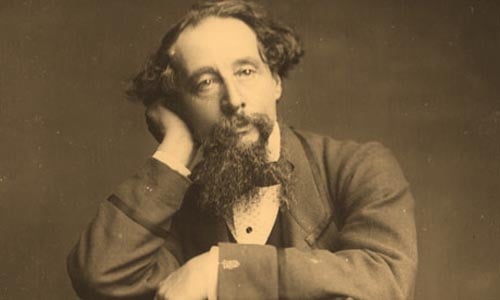
In a dusty corner of Mr Headstone's apartments there stood a stained walnut bookcase, and on the uppermost shelf of that sturdy item of carpentry there stood, in a serried rank, attired in red and gold livery, the sixteen volumes of the works of Mr Charles Dickens. The pedagogue had purchased the books from a bookseller in Clerkenwell Green after an altercation with an old gentleman with a powdered head and gold spectacles, who had intimated a desire to make the collection his own, and might indeed have done so had he not five minutes earlier been divested of his pocket book by the nimble fingers of a juvenile individual in a large coat and a pair of corduroy trousers. The bookcase also contained on its lower shelves a quantity of other works - some popular, some professional, some pious, some profane - all jostled together in a haphazard fashion, dressed in torn and ragged jackets like an unruly mob of rick burners.
From amongst these common books Mr Headstone took down a copy of Old Moore's Almanack, and turned to the month of February wherein he read a number of alarming predictions. The author of this publication was considered by all who knew him - and not many did for he published his opinions anonymously - to have a very penetrating mind, which, when applied to the rigorous practice of the astrological sciences, was capable of peering through the veil of the future and, by dint of much squinting, making out in indistinct form events that were yet to befall mankind. The astrologer's first prediction - and the sceptical reader should remember that these prognostications were made several months in advance - was that February was likely to be cold and frosty. A further prediction stated that there was almost certain to be a run on the price of red roses in the middle of the month - an observation so curious that Mr Headstone made a note of it with a resolution to keep a watch on the horticultural trade. The author of the almanack also predicted that an interderminate number of new born babies would be recorded in the hospitals; that sextons would set down an equally indeterminate number of deaths in the parish registers; that disgreements of opinion would be volubly expressed in parliament; that young ladies of a sentimental nature would fall in love, and that disappointed gentlemen would turn to drink; that sellers of haberdashery would be busy on rainy days, and that brewers would be idle on Sundays; that dogs would bark at the next full moon on the seventh of the month; and that life, it all its unprovoked variety, would continue much the same as it always had done. Mr Headstone closed the book and returned it to its place on the shelf a wiser man.
The bookcase, it should be noted, was the property of Mrs Raddle, the landlady, and had occupied the same position for some seven years on account of the fact that it conveniently disguised a scorch mark on the wall that was all that remained of the previous tenant, who had one night disappeared without a trace - or, at least, with only the trace of a sooty patch on the plaster - and with one month's rent still owing.
Mr Charles Dickens