Mr Charles Dickens

Mr Charles Dickens

Monday, December 31, 2012

In Which Mr Headstone Is Somewhat Premature In His Celebrations


Next to Christmas Day, the most pleasant annual epoch in existence is the advent of the New Year. There are a lachrymose set of people who usher in the New Year with watching and fasting, as if they were bound to attend as chief mourners at the obsequies of the old one. Mr Headstone is not one of these people, but is of the belief that it is a great deal more complimentary to see the old fellow out, and the new one in, with gaiety and glee. And so Mr Headstone is bound for a quadrille party in a grand house situated on the grand corner of a grand thoroughfare outside of which there is a grand confusion of hackney coaches and carriages. Mr Headstone arrives in a cab in a pair of boots with black cloth fronts, and brings his shoes in his coat-pocket, which shoes he is at this very moment putting on in the hall. Now he is announced by the man in the passage to another man in a blue coat, who signals to a man on the first landing to take Mr Headstone into his care.

The man on the first landing precedes the pedagogue to the drawing-room door and announces him again in a grand voice. Mr Headstone rubs his hands very hard, and smiles as if it were all capital fun, and keeps constantly bowing and turning himself round as he is introduced to the grand company. He glides into a chair at the corner of the sofa, and opens a miscellaneous conversation with the young ladies upon the weather, and the theatres, and the old year, and the last new murder, and the balloon, and the ladies' sleeves, and the festivities of the season, and a great many other topics of small talk.

At supper, Mr. Headstone shows to still greater advantage and is so droll, insisting on all the young ladies having their glasses filled, notwithstanding their repeated assurances that they never can, by any possibility, think of emptying them. After the toast has been drunk, and when the ladies have retired, Mr. Headstone requests that every gentleman will do him the favour of filling his glass, for he has a toast to propose: on which all the gentlemen cry 'Hear! hear!' and pass the decanters accordingly; and Mr. Headstone being informed by the master of the house that they are all charged, and waiting for his toast, rises, and proposes a toast to the New Year and all the good fortune that it will bring upon the present company. The toast is drunk with acclamation and the whole party rejoin the ladies in the drawing-room just as the first stroke of twelve peals from the neighbouring churches rings through the frosty air. And with each subsequent stroke the sound resolves itself into something more like a knock, and Mr Headstone is woken from his dream to find that Mr Guppy and Mr Snodgrass are at the door of his lodgings, and expect the pleasure of his company on this final night of the year at The Saracen’s Head.

Tuesday, December 25, 2012

Being A Good Humoured Christmas Chapter


Christmas time! That man must be a misanthrope indeed, in whose breast something like a jovial feeling is not roused - in whose mind some pleasant associations are not awakened - by the recurrence of Christmas. Who can be insensible to the outpourings of good feeling, and the honest interchange of affectionate attachment, which abound at this season of the year? A Christmas family-party! We know nothing in nature more delightful! And of all the Christmas parties, what can be more delightful than the annual gathering of the Fezziwigs, and all their friends and relations? 

The floor has been swept and cleared and the fiddler is at his post with his music book, tuning his instrument like fifty stomach-aches. From the centre of the ceiling, Mr Fezziwig has just suspended, with his own hands, a huge branch of mistletoe, and this same branch instantaneously gives rise to a scene of the most delightful confusion: in the midst of which, Mr Headstone is struggling to maintain his dignity as the ladies of the party, young and old, avail themselves of the custom traditionally associated with that sprig of winter greenery. The fiddler strikes up a reel, and the revels begin with the entrance of the guests.

In comes Mr Winkle on the arm of a pretty black-eyed young lady in fur-topped boots. In comes Mr Snodgrass with his arm around the tiny waist of Miss Emily Wardle. In comes Bill Sykes, with his Nancy in a red dress. In comes Mark Tapley, who appears to be bearing up extremely well in the company of Mrs Lupin. In come Mr Dick Swiveller and the Marchioness, as mismatched a pair for dancing as you could possibly conceive. In come Mr Benjamin Allen and Mr Bob Sawyer, who make their way directly towards the bar and treat each other to a pint of Burton Ale in honour of the season. In come Mr and Mrs Crummles dressed in motley in readiness for a dramatic performance, which they have been prevailed upon to deliver for positively the very last time. In come Mr Guppy and Mr Tappertit, already half-drunk and determined to make up the difference. In comes Mr Poll Sweedlepipe together with Sairey Gamp, the lady much flushed in the face having just come in from the cold. In come Mr Toots and Diogenes, followed by the Game Chicken, whose footwork is much admired by all the ladies. In they all come, one after another; some shyly, some boldly, some gracefully, some awkwardly, some pushing, some pulling; in they all come, anyhow and everyhow.

There are dances and forfeits, and more dances, and there is cake, and there is smoking bishop, and there is a great piece of cold roast, and a great piece of cold boiled, and there are mince pies, and plenty of beer. The evening concludes with a glorious game of blind-man's-buff, in which Mr Headstone knocks down the fire-irons, tumbles over the chairs, bumps up against the piano, and smothers himself in the curtains but never catches anything but a footstool. When the clock strikes eleven the company breaks up, and Mr and Mrs Fezziwig take their stations, one on either side of the door, and, shaking hands with every person individually as he or she goes out, wishes him or her a Merry Christmas. Mr Headstone leaves arm in arm with Mr Bob Cratchit, whose acquaintance he has only just made this very evening, and the two weave a tipsy path through the snow, singing a Christmas carol as they go.

Monday, December 24, 2012

In Which Mr Headstone Prepares A Bowl Of Smoking Bishop


Mr Headstone’s friends and acquaintances are in agreement that of all the pedagogue’s manifold talents, it is in the concoction of alcoholic beverages that his true genius lies; and when it comes to the mixing of punch he is the Nonpareil. Hence, it is his custom at this season to prepare a large bowl of Smoking Bishop for the delight and degustation of the guests of the Fezziwigs, whose annual Christmas ball is as essential a part of the celebration of the holiday as roast goose and mistletoe. 

Accordingly, Mr Headstone has laid out before him all the necessary ingredients, viz: a dozen bitter oranges, half a pound of loaf-sugar, three bottles of claret, and a handful of cloves. He places the oranges upon the hearth to roast before the fire, and as he waits for them to brown, he uncorks a bottle of claret and takes a sip, on the principle that all good cooks should taste their wares before serving them to the public. His palate satisfied, he pours out another measure and holds the glass to the light, a method by which vintners are known to judge the qualities of colour and body. The firelight illuminates the deep rich purple hues to Mr Headstone’s satisfaction even as he tilts back the glass and puts it to his lips. With cautious fingers he turns the oranges upon the hearth and when they are burnished to a pale gold, he lays them in a tureen, pricks them with cloves as though they were pin cushions, pours in a bottle of claret and sprinkles the whole with loaf-sugar. He places a cover on the tureen, stands it close to the dying embers of the fire, and retires to bed.

On the morrow when he removes the cover, a rich aroma springs out from the bowl like a genie from its lamp. Mr Headstone busies himself with pressing the juice from the fruit with a spoon, which he accomplishes with no small degree of difficulty and at no small risk of ocular injury to himself. Armed with several culinary implements – to wit, a sieve, a saucepan and a trivet – the pedagogue completes the operation with no greater mishaps than a burnt thumb and a slight scalding of his left foot. At last the work is done and Mr Headstone ladles a generous portion of the steaming punch into a cup, and drinks to his own continued health.

Sunday, December 23, 2012

Relating The Outcome Of The Contest Between The Game Chicken And The Larkey Boy


In anticipation of a visit from Mr Toots and the Game Chicken, Mr Headstone ordered in a dozen crumpets, threw an extra lump of coal upon the fire, and instructed his landlady to admit his visitors without delay lest the glory that they trailed behind them should become dissipated in the gloom. It was, indeed, cold, bleak, biting weather, foggy withal, and the pedagogue could hear the people in the street below go wheezing up and down, beating their hands upon their breasts, and stamping their feet upon the pavement stones to warm them. The city clocks had only just gone three, but it was quite dark already – it had not been light all day – and candles were flaring in the windows, like ruddy smears upon the palpable brown air.

Mrs Raddle was herself setting a lighted candle in the scullery window when, piercing the murky atmosphere on the other side of the glass, there appeared an apparition in white with a physiognomy so grotesque that it would have induced a lady of a delicate constitution to faint away upon the spot. As Mrs Raddle had never once in her life required the reviving properties of hartshorn, she acknowledged the presence of the stranger with equanimity and, putting her own head out of the window in the manner of a gargoyle atop a church tower, enquired whether he had come to see Mr Bradley Headstone. The answer being in the affirmative, the individual – whose shaggy great-coat and flat-brimmed hat now identified him as the Game Chicken – was admitted into the parlour, closely followed by Mr Toots and Diogenes.

Mr Headstone’s gratification on receiving his visitors was tempered by the appearance of the Chicken, which did not entirely meet with his expectations of the profile of a victor in the fine and noble art. The Chicken’s visage was, indeed, in a state of such great dilapidation, as to be hardly presentable in society with comfort to the beholders. The Chicken himself attributed this punishment to his having had the misfortune to get into Chancery early in the proceedings, when he was severely fibbed by the Larkey one, and heavily grassed.

Mr Headstone, who was unfamiliar with the lexicon of pugilism, appealed to Mr Toots for a gloss upon the Chicken’s description, whereupon that gentleman produced from his waistcoat pocket a gazette, which contained a full and faithful account of the fight. It appeared from the published record of that great contest that the Larkey Boy had had it all his own way from the beginning, and that the Chicken had been ‘tapped’, and ‘bunged’, and had ‘received pepper’, and had been made groggy, and had ‘come up piping’, and had endured a complication of similar strange inconveniences, until he had been gone into and finished.

It was the opinion of Mr Toots that the Game Chicken’s defeat at the hands of the Larkey Boy was of no consequence, and that his upcoming bout with the Westminster Costermonger would be sure to garland him with glory; which sentiment received the approbation of Mr Headstone as he handed round the hot-buttered crumpets.

Saturday, December 22, 2012

In Which Mr Headstone Makes A Wise Investment


As they made their way to Chancery Lane, Mr Toots regaled Mr Headstone with a description of how the Game Chicken had but recently covered himself and his country in glory in a contest with the Nobby Shropshire One, and, for the pedagogue’s further edification, the Chicken obligingly re-enacted some of the more dramatic passages from that same contest by engaging in a mock bout or two with several startled passers-by. Mr Headstone’s appetite for the sporting spectacle was whetted by this display of the fine and noble art, and his interest was further piqued by Mr Toots’s prediction that his man would come out strong and go in to win, and that any money put down in support of said prognostication would return a dividend with interest more certain than any venture made upon ‘Change.

The reader might imagine, therefore, the disappointment that the pedagogue felt when, arriving at the Hole in the Wall, he learnt that the fight was to take place at Newbury; which, being a distance out of the city, made it an impossibility for him to attend in person. In anticipation of another famous victory by the Chicken, Mr Headstone made a wager with Mr Randall, the landlord of the pub, on the outcome; and Mr Randall, being a practitioner of the fine and noble art himself, obliged him by accepting it. There being a caravan starting from Tom Belcher’s at two, which would go right out and back again the next day, Mr Toots and the Chicken settled on this method for going down, and so parted company with Mr Headstone, promising to call upon the gentleman on the morrow with his share of the winnings.

Thursday, December 20, 2012

In Which Mr Headstone Makes The Acquaintance Of The Game Chicken


The individual whom Mr Headstone had unceremoniously tumbled into the street had the appearance of a person of good breeding, his suit of clothes being one of the greatest marvels of sartorial elegance that the firm of Burgess & Co. had ever turned out. Getting to his feet and brushing down his trousers, the young gentleman assured the pedagogue that his condition was of no consequence; that the dirt could be washed out and the rents at the knees could be mended; and if they could not, it was still of no consequence as Burgess could always run up another pair; and, if that gentleman happened to be otherwise professionally engaged, then Co. would be sure to perform the service with equal despatch. Mr Headstone felt obliged to the gentleman for such good grace in the face of misfortune and would have shaken him by the hand as a token of his appreciation had he not been required by immediate circumstance to direct his attention to two other occurrences which had a direct bearing upon his own well-being. The first was the application of a set of canine teeth to the rear of his pantaloons, and the subsequent operation of those same teeth upon that sensitive part of his anatomy. The second was the approach of an interesting character in a shaggy white great-coat and flat-brimmed hat, who proceeded to knock him about the head in that vigorous manner which is the hallmark of a professional pugilist.

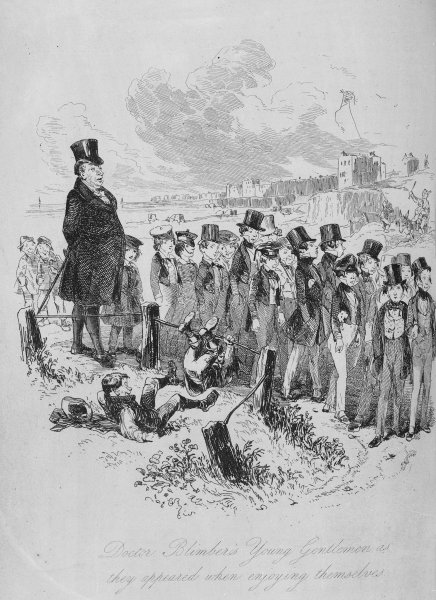
Exposed on both flanks, Mr Headstone was - like many a famous general in military history - on the point of capitulation when aid came from an unexpected quarter in the form of the young gentleman, who instructed both man and beast to desist in their hostilities, which orders they at once obeyed. The fray being over, the young gentleman handed the pedagogue a card – of which he had a plentiful supply – bearing the name of Toots. Mr Headstone returned the compliment and the two men shook hands warmly. Mr Toots intimated that the character in the great-coat, who was always to be heard of at the bar of the Black Badger, answered to his professional moniker of the Game Chicken. Thus introduced, the Chicken dropped his hat, made a dodge and a feint with his left hand, hit a supposed enemy a violent blow with his right, shook his head smartly, and recovered himself. The dog, whose bark indicated that he too desired an introduction, was called Diogenes, on account of his having been raised from a puppy in Doctor Blimber’s Academy and having received - like Mr Toots, who was also an alumnus of that institution - a classical education.

The Chicken was a stoical gentleman, with very short hair, a broken nose, and a considerable tract of bare and sterile country behind each ear. Mr Toots employed him as his chief instructor in the cultivation of those gentle arts which refine and humanise existence; and the Game Chicken had introduced to him a marker who taught billiards, a Life Guard who taught fencing, a jobmaster who taught riding, a Cornish gentleman who was up to anything in the athletic line, and two or three other friends connected no less intimately with the fine arts. In Mr Toots’s Pantheon, however, the Game Chicken was quite the Apollo, and he now demonstrated his prowess in the field by dancing round the pedagogue and jabbing at the air with a swift double motion of his gnarly fists.

Mr Toots was at that moment on his way to see the Chicken defeat the Larkey Boy in a contest of ten rounds, and announced that he would be honoured if, as a mark of their new-found friendship, Mr Headstone would accompany him to witness the Chicken’s triumph, which was already being spoken of as if it were a recorded fact. The pedagogue willingly accepted the invitation and the two new acquaintances set out for Jack Randall’s in Chancery Lane, with the Chicken dancing and sparring around them and Diogenes taking up the rear, which latter fact caused Mr Headstone no small amount of trepidation in respect of his pantaloons.

Monday, December 10, 2012

In Which Mr Headstone Demonstrates Athletic Prowess


Although Mr Headstone’s application for admittance made little impression upon the premises to which it was addressed, it was loud enough to attract the attention of the porter in the mulberry-coloured coat, whose stewardship of the street included amongst its manifold duties that of the keeping of the peace. It being the opinion of this officer that the pedagogue’s actions were clearly in breach of the law in this regard, the worthy guardian advanced upon the source of the disturbance, thrusting his staff of office before him, very like a knight from days of yore brandishing a lance. Observing the actions of the porter and perceiving that the pointed end of the instrument was aimed directly at his corporeal self, Mr Headstone judged it an opportune moment to retreat to a place of greater safety.

In a demonstration of the phenomenon of locomotive momentum, the porter in the mulberry-coloured coat gathered speed in his approach at an alarming rate, one that was not quite in keeping with the dignity of his office. As he pursued the harried pedagogue along Doughty Street, passers-by turned their heads to mark his progress and wonder at the circumstance that must have prompted this display of human velocity.

Mr Headstone, whose legs were as long as the porter’s were short, soon gained the advantage of distance over the ruby-faced officer, and he reached the end of the street with the confidence of an athlete who has successfully outpaced his opponent. His sense of victory was, however, fleeting for as he turned the corner he collided with an individual who was at that same moment attempting to restrain a large dog by the scruff of its neck, which endeavour the latter personage was obliged to relinquish by being tumbled into the gutter in a most unceremonious manner.

Friday, November 30, 2012

Being A Brief Observation On The Nature Of Equanimity


How long a gentleman should stand on the front step of a residence in the expectation that his knocking on the door be acknowledged by those within is a question that has never been answered to the satisfaction of polite society. Certain it is that Mr Headstone was unacquainted with the laws of etiquette in this regard; for he deemed it necessary to redouble his efforts in alerting the house to his presence by applying first his fists and then his boots to the green paintwork of the door, and, when this stratagem failed, by resorting to the novel expedient of shouting through the brass letterbox. Whether this produced the desired effect in rousing the occupants of the Number Forty Eighty Doughty Street, the reader will discover in our next communication.

Sunday, November 18, 2012

In Which Mr Headstone Administers A Double-Knock


Determined to confront the man whom he believed to be the author of all his woes, Mr Headstone rose on the morrow, dressed himself in his second best suit and set out in the direction of Doughty Street, which is just north of Gray’s Inn in the borough of Camden. He had been provided with reliable information from Mr Snodgrass that Mr Dickens resided at number forty eight in that particular thoroughfare, and, as Mr Snodgrass was himself a gentleman of literary pursuits, the pedagogue had no reason to doubt the veracity of this intelligence. The street to which he was bound was a private one, and, as an emblem of its status, had at its entrance a lodge and a gate, which was presided over by a stout porter in a gold-laced hat and a mulberry-coloured coat. Mr Headstone addressed this officer with the deference that his uniform deserved, and, pressing a few coins into that worthy’s upturned palm, gained admittance forthwith. Number Forty Eight was a tall edifice of pink brick, distinguishable from its neighbours on either side by a green door under a white arch. There was nothing at all particular about the knocker on the door, except that it was very large; and when Mr Headstone applied a vigorous double-knock, it produced a sound designed to awaken even the most somnolent housemaid. However, despite repeated applications of this instrument of summons, the pedagogue was left waiting on the front step, and here we must also leave the reader awhile until someone comes to answer the door.

Wednesday, October 31, 2012

To Be Taken With A Pinch Of Salt


London. The month of October almost over, and Mr Headstone is sitting in his room in front of a glowing coal fire, an open book upon his lap, and a glass of Old Tom at his elbow. Outside it is bitterly cold and there is as much murk and gloom in the streets as if the ancient shades of creation’s first night had not yet withdrawn from the face of the earth, and it would not be wonderful to meet a crook-backed homunculus shuffling down the Strand. Dogs howl at the moon, which peers down through drifting tattered clouds. A black cat jumps onto a graveyard wall, arches its back and stares with wide green eyes at something moving between the tombs. Horses whinny and shy at the least provocation, their hooves striking sparks on the wet cobbles. Foot passengers, wrapped up in coats and scarves, gliding through the streets, their footfalls muffled by the clammy atmosphere, come and go like the spirits of the departed. It is weather for neither man nor beast, and so Mr Headstone is making himself comfortable by the fireside with the intention of whiling away the evening in the perusal of three ghost stories by Mr Dickens, these short works being the most appropriate form of entertainment for the season. Shadows everywhere. Shadows creeping over the domes and spires of the city; shadows settling on the rooftops of the great houses between Portland Place and Bryanstone Square; shadows, blacker than a judge’s cap, filling up the courts of Gray’s Inn; shadows engulfing the humbler dwellings of Camden Town and Staggs’s Garden; shadows finding every nook and every cranny of every crooked alleyway, and seeping even into the cracks of the newly laid paving stones. Shadows in the very room where Mr Headstone sits alone, looking nervously over his shoulder as he puts down his book, imagining he sees something crouching in the corner, which - on closer investigation - turns out to be nothing more menacing than the coal scuttle. Hark! Is that a scratching at the window? Is that a rustling under the chair? Is that a footfall on the stair? Do the pedagogue’s eyes deceive him, or is the doorknob slowly turning as if someone – or something – wanted to come in? The door creaks slowly open on its hinges, but what apparition stands there? Is it a pale sheeted ghost risen up from the grave come to haunt the trembling pedagogue? No, it is Mrs Raddle delivering the weekly supply of freshly laundered linen, and come to remind Mr Headstone that his rent his due on Saturday.

Monday, October 29, 2012

In Which Mr Headstone Is Restored To Domestic Bliss


It will be a matter of some surprise for the reader to learn that during Mr Headstone’s prolonged absence his landlady had failed to find another tenant for the rooms that he had vacated. Although a number of single gentlemen had walked up in response to the advertisement placed in the scullery window, none of them had been able to reconcile the peculiarities of that attic apartment with their notions of domestic comfort. First, there were the stairs to contend with, which creaked underfoot like the deck of a three-masted schooner, and wound in ever-tightening circles to just below the roof, where inconvenient buttresses of brick and plaster and low-hanging beams of hard wood awaited the unsuspecting crown of any visitor. The interior of the rooms was in much the same condition as Mr Headstone had left it on his departure; that is to say, in a state of confusion and disarray. The carpet waited patiently to snare the tread of any unwary traveller across the floor; the footstool lounged insouciantly on its three uneven legs, eager for an opportunity to upset the weary guest in search of repose; the fireplace frowned darkly, and, when the wind got up outside, sneezed smudges of greasy soot into the air; the sofa sagged dropsically as if inclined to extended bouts of melancholy, and exhibited the symptoms of advanced old age in its effusive sprouting of horsehair through the tears and rents in its wrinkled hide. Cobwebs, with husks of bluebottles in their nets, hung in the high corners where the landlord spiders awaited more tenants. The walls were cold and clammy, like gravestones to the touch. But to Mr Headstone, it was still home, and when he threw open the door and surveyed everything before him, tears rolled down his cheeks – which may have been engendered by the emotion of his return, or – as is more likely – by the operation of the strong odours of dead fish and old beer on his eyes.

Sunday, October 28, 2012

In Which Mr Headstone Makes Known His Suspicions

From the very instigation of his grand design to run through the collected works of the Inimitable Author, Mr Headstone had become aware of an alteration in the circumstances of his life, which, as his project progressed, seemed to encroach increasingly on his daily existence. Every man and every woman is subject to their fair share of misfortune, and none but the vain and the mighty can expect to escape the minor trials of life. Mr Headstone, however, was now of the opinion that he had recently been allotted a much larger serving of bad luck than he could possibly be expected to consume, and that he was - with regard to misfortune - developing a severe case of dyspepsia. Furthermore, he had begun to form a suspicion in his own mind that some invisible hand was at work in arranging his encounters with recalcitrant servants, scheming villains, shrewish landladies, tyrannical magistrates & co., and that even the behaviour of inanimate objects was being orchestrated to conspire against him.

On hearing of the pedagogue's complaint, certain members of the assembled company did their best to alleviate Mr Headstone of his delusions. Mr Dick Swiveller took it as a great joke, and laughed at the notion. Mr Simon Tappertit pronounced it as the onset of lunacy, and advised the gentleman to make immediate arrangements for the transference of his belongings and his good self to the Bethlem Royal Hospital. Mr Guppy perceived the situation as an opportunity for taking out an action, and pressed for more details. Only, Mr Mould, whose intellect was equal to the absurdity of the premise, advised Mr Headstone to do the one thing that would put his mind at rest - which was to seek out Mr Dickens and confront him with the charge of willful manipulation of character. This course of action was applauded by all, and Mr Headstone announced his intention to call upon the literary gentleman the very next day.

Sunday, October 14, 2012

In Which Mrs Gamp Applies Another Remedy


When a gentleman’s complexion grows paler than a sheet of freshly laundered linen, then it is common practice to stimulate the flow of blood to those areas which - when rosy - are taken to be an outward indication of rude health. Mrs Gamp’s preferred method for achieving this end was to apply the flat and the back of her palm in a vigorous fanning motion about the face of the patient, which operation was invariably guaranteed to bring the colour back to the cheeks as swiftly as could be desired. The gin bottle now being empty, the nurse lost no time in demonstrating the efficacy of this remedy by advancing on Mr Headstone, grasping him by his buttonhole, and beating him about the head in the aforementioned manner.

Having been restored to his former self by the application of a dozen blows, Mr Headstone staggered back into a chair, the better to compose himself. Around him gathered an assembly of his friends and acquaintances, all eager to know what had precipitated his sudden expression of alarm at the mention of Mr Charles Dickens, and all urging the pedagogue to unburden himself of his secret for - as Mr Winkle remarked - a problem shared was a problem halved; or, in the case of the present company, divided into equal portions of one seventeenths. Subdued by the irrefutable argument of mathematics, Mr Headstone surveyed the expectant faces looming before him, and, in a manner that was not entirely consistent with logic or intelligibility, explained his predicament.

Tuesday, September 25, 2012

In Which Mr Mould Interrogates Mr Headstone

Having examined Mr Headstone by the original and efficacious method of prodding that gentleman's frame with the tip of her gig umbrella and rapping portions of his skull with its handle, Mrs Gamp pronounced the patient to be in an excellent state of health and proposed a toast to the continued equanimity of his constitution by taking up the bottle of gin from the chimney piece and putting it to her lips. Notwithstanding the receipt of a professional medical opinion, the pedagogue's friends and acquaintances were still desirous of hearing from Mr Mould, whose attendance they had been expecting for some time.

In fact, the undertaker was at that moment in the street below applying vigorous action to the door knocker, which was so constructed as to wake the street with ease, and even spread alarms of fire in Holborn, without making the smallest impression on the premises to which it was addressed. It chanced that Mr Sweedlepipe, leaning out of the window, spied the black crepe of the gentleman's hat and called down to him to let himself in and come up directly to the first floor. On entering the room, Mr Mould began by thanking the company for their confidence in his good opinion and trusted that they would in the fullness of time come into his hands in his true professional capacity, which he promised to execute with all the favours that acquaintance allowed.

Mr Mould was introduced to Mr Headstone and, having been apprised of Mrs Gamp's considered prognosis from that good lady's own lips (when they were not applied to the gin bottle), the undertaker began to question the pedagogue closely on matters of personal history in order to determine whether the gentleman's faculty of memory had been in any manner impaired by his recent misfortunes. As Mr Mould was not familiar with Mr Headstone in any particular whatsoever, this mode of questioning soon ended in a no thoroughfare, and the undertaker appealed to the company for a new theme.

It was Mr Snodgrass who suggested that a fruitful line of enquiry might be achieved by an interrogation of Mr Headstone on the progress of his great project, which, when announced at the beginning of the year in The Saracen's Head, had won the admiration of all his friends and acquaintances. On the introduction of this topic, which all supposed would be a matter of some pride and satisfaction to the pedagogue, Mr Headstone was seen to turn quite pale - indeed, much paler than his emaciated visage would normally allow - and looked for all the world as if he would soon be in need of Mr Mould's professional services. Those about him were thrown into immediate consternation, except for Mrs Gamp, who being as familiar with laying out as she was with laying in, took recourse to the gin bottle in order to bolster her spirits with a swig of the same.

Monday, September 10, 2012

In Which Mr Headstone Is Delivered Into The Care Of Mrs Gamp

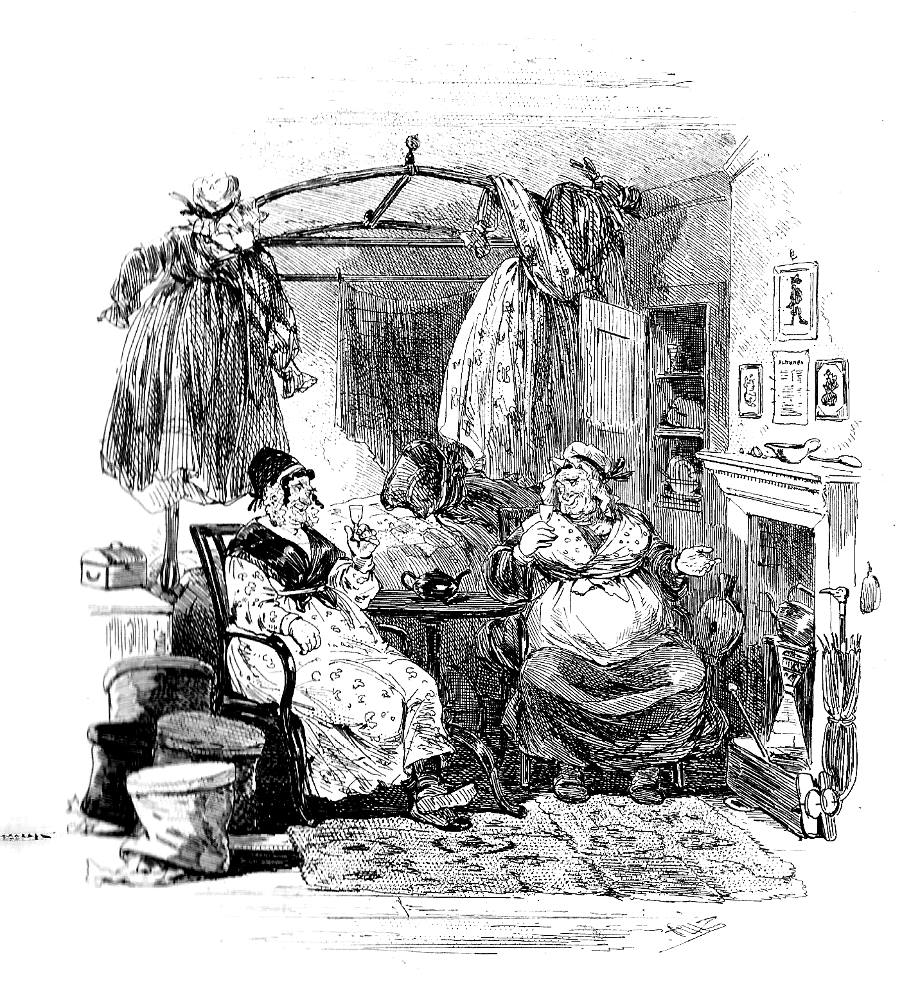
Mrs Gamp's apartment in Kingstone Street, High Holborn, was not a spacious one, but it at least comprised as much accommodation as any person, not sanguine to insanity, could have looked for in a room of its dimensions. An intrusion into its interior by a visitor was inclined to make it smaller still, and the arrangement of the furniture - which included a large bedstead, a chest of drawers, and two large elbow-chairs, of ancient mahogany - did little to assist any such individual in an easy progress across the threadbare carpet; which journey was made even more hazardous by the irregular placement upon the floor of bandboxes, devoted to the reception of various miscellaneous valuables. Further decoration of the apartment was provided by a pair of bellows, a pair of pattens, a toasting-fork, a kettle, a spoon for the administration of medicine to the refractory, and lastly, Mrs Gamp's umbrella, which as something of great price and rarity, was displayed with particular ostentation.

Into this Aladdin's cave came Mr Bradley Headstone, followed closely by Mr Poll Sweedlepipe, and Mr Richard Swiveller, and Mr William Guppy, and Mr Nathaniel Winkle, and Mr Augustus Snodgrass, and a number of other gentlemen (whose names we will not trouble the reader with) many of whom were obliged to wait on the stairs as there was not enough room to accommodate them within. It being five o'clock of an afternoon, Mrs Gamp was quite naturally seated at the tea-board, having just concluded her arrangements for the reception of Mrs Betsey Prig, whose arrival the nurse had supposed the most recent knock on the door to have presaged.

The good lady's alarm - more in fear for the survival of the comestibles set out before her than for her own person - was quickly allayed by her landlord, who explained the purpose of their visit. As one devoted to the care of the sick and the infirm, Mrs Gamp lost no time in establishing the terms upon which her services could be secured. Whilst waiting for the return of a boy who was sent out to the nearest tavern for a bottle of gin for medicinal purposes, the kindly nurse took Mr Headstone by the collar of his coat, and gave him some dozen or two of hearty shakes backward and forward; that exercise being considered by herself as being highly beneficial to the performance of the nervous functions. Its effect in this instance was to render the patient so giddy and addle-headed, that he could hardly speak; which Mrs Gamp regarded as the triumph of her art.

Monday, September 3, 2012

In Which The Opinions Of Great Minds Are Sought

Having been apprised of the events surrounding Mr Headstone's prolonged absence from society, it was not unnatural that the pedagogue's friends and acquaintances, being solicitous of the state of that good gentleman's health, should be desirous of obtaining expert medical opinion on the likelihood as to whether a severe blow to the head (or, indeed, two severe blows to the head) should have any detrimental physiological effect on an individual unfortunate enough to be exposed to such a traumatic circumstance.

Expert opinion, however, always comes at a price, and money being - as it so often was in the affairs of Mr Headstone - an object, it was Mr Poll Sweedlepipe who suggested that the services of a nurse by the name of Gamp could be secured on reasonable terms, those being eighteen pence a day for working people, and three and six for gentlefolks, with the additional provision of a shilling's worth of gin and warm water to be left on the chimney piece in case it was wanted.

This suggestion was received as being both sensible and economical, and Mr Sweedlepipe observed that for the additional modest sum of half a crown the professional opinion of the distinguished Mr Mould could also be secured. This gentleman, he ventured to explain, was not in the strictest definition of the term a medical man, but rather attended on those persons whom doctors were no longer able to assist, which was to say, in short, that he was an undertaker by trade. It being the general opinion of the company that Mr Mould's standing as a man of learning should not be foresworn simply on account of the fact that his customers were inanimate, Poll Sweedlepipe was instructed to lead the way to his residence in Kingsgate Street, High Holborn, where Mrs Gamp took lodgings, next door but one to the celebrated mutton-pie shop.

Monday, August 20, 2012

In Which Mr Headstone Is Taken For A Ride

On arriving in Salisbury Mr Headstone made his way to the coach-office to secure a place to London. Being obliged to wait an hour before the coach's arrival, he walked into the bar of the inn and made himself comfortable, which in his mind naturally required the provision of strong liquor. Although it threatened to reduce his purse (which Mrs Lupin had generously filled with copper and silver), Mr Headstone marked each quarter of the hour with a brandy and water, and when the coach came round at last, with 'London' blazoned in letters of gold upon the hind boot, the pedagogue staggered out into the yard and took his seat upon the box.

The coach was none of your steady-going, yokel coaches, but a swaggering, rakish, dissipated London coach. It rattled noisily through the streets, making everything get out of its way; and spun along the open country-road, racing past hedges, gates, and trees; past cottages and barns; past streams, in which the cattle cooled their feet; past paddock-fences, farms and rick-yards; past churches, with rustic burial-grounds about them.

Mr Headstone, under the influence of the brandy and hot sun, felt inclined to doze, but found the coachman's shoulder an inconvenient pillow on which to rest his head, on account of the fact that that portion of that gentleman's anatomy was connected to the arm which was connected to the hand that flourished the whip over the heads of the four greys. The coach, being obliged to follow the road through all its dips and hollows and twists and turns, gave a very good imitation of a ship being tossed about on the high seas, and Mr Headstone, being no very good sailor, felt the worse for the comparison.

In time the country roads were left behind and the way ahead became a continuous street; and so on they rode, past market-gardens, rows of houses, villas, crescents, terraces, and squares; past brick and mortar in its every shape; and in among the rattling pavements, where a jaunty-seat upon a coach is not so easy to preserve. Down countless turnings, and through countless mazy ways, until the four panting greys drew up inside the yard of The Saracen's Head in Snow Hill in the great city of London, and there relinquished the charge of their passengers in exchange for a liberal quantity of fresh hay and a nosebag of barley.

Saturday, August 11, 2012

Which Contains A Sentimental Farewell

Having had his mental faculties returned to him by the fortunate circumstance of being struck on the head by a weathered wooden sign, Mr Headstone resolved to return to London at once, or, at least, as soon as the apothecary had done wrapping his crown with brown paper soaked in vinegar. The village folk gathered on the green to bid the pedagogue farewell and to present him with small tokens of remembrance as a mark of his brief sojourn amongst them. Mrs Lupin wrapped these simple geegaws - straw poppets, stones from the village stream, wooden spoons, balls of yarn -  into a red spotted handkerchief, which she then knotted onto the end of a length of ash for the greater convenience of conveyance.

The emotions at the moment of parting were keenly felt by the villagers, whose lives had been briefly enriched by the appearance of the noble stranger in their midst. Mr Headstone, having no memory of the period between the two instances when he had received a blow to the head, was less affected by the occasion, and made his farewells as he might to any group of strangers; which conduct made Mrs Lupin shed more tears than she might have otherwise done. On passing the first bend in the road, Mr Headstone - not being of a sentimental nature - tossed the contents of his knapsack into the ditch, for it was a heavy burden and the ash chafed his shoulder. And yet, before anyone accuses the pedagogue of having a hard heart, let it be recorded that he kept the landlady's gift of the spotted handkerchief, which was either a sign that he reserved some small sentiment for the good woman, or that he was in need of something to wipe the perspiration from his face.

Wednesday, August 8, 2012

In Which Mr Headstone Is Returned To His Former Character

And so began a brief rustic idyll in the life of Mr Bradley Headstone. The gentleman in question - having suffered a blow to the head that had rendered him senseless and made him as unaware of his origins as anyone who had just but recently made his acquaintance - now roamed about the village and its environs in a state of perfect contentment. Slowly he learnt about the simple country ways: how to tell the difference between stinging nettles and dock leaves; which pasture the farmer's bull was set to graze in and what speed was required to outrun him; why one should never when picking buttercups present one's posterior to a grazing goat; which berries were inclined to give stomach cramps; and many other lessons of an instructive character. There was even a prospect of future employment for one of the local farmers declared outright that if ever he needed a scarecrow for his north field, then he need look no further than under the sign of The Blue Dragon.

It was indeed under this very sign, which for many years had swung and creaked in summer storms and autumn gales, that Mr Headstone was reposing one hot afternoon with a mug of cider for company when - with no advance notice of its intentions - that emblem of the house finally gave up the ghost and slipped the weakened moorings of its iron hinges to plummet directly earthwards. Mr Headstone had at that very moment tilted back his head to take a final draught, and, with his eyes thus directed heavenward, he was given a clear view of the descending board with just the requisite amount of time to register its approach without -alas- a sufficient subsequent period to avoid it. It was a sturdy sign made from sturdy English oak and when it struck the surprised pedagogue on the forehead it made a sturdy sound not at all dissimilar to that of a cricket ball being struck by a willow bat.

Mrs Lupin, who had observed the incident from an upper window of the inn, rushed downstairs to the bar for a jug of cold water in order to revive the unfortunate gentleman from the second stupor he had fallen into in the space of a quarter. Having performed this kindly service, she told the pot boy to run and fetch the apothecary. By the time that worthy medical man arrived - for being wanted again he was naturally not to be found at home - Mr Headstone had recovered enough to be able to sit up and engage in conversation, the main purport of which was to announce his immediate return to London, from which place he had been absent for longer than was conducive to the preservation of a gentleman's reputation.

Wednesday, July 25, 2012

Which Contains Some Valuable Hints In Relation To The Management Of A Sick Chamber

By measured degrees the mysterious stranger slowly regained his strength, if not his wits. In truth, his recovery  - much aided by the hourly ministrations of the landlady of the Dragon - would have been swifter had it not been for the daily visits of the apothecary, who, fearing the usurpation of his medical authority by the blacksmith, went to great pains (all of which were keenly felt by the unfortunate subject of his care) to assert his supremacy. In his desire to demonstrate the breadth of his knowledge in the field, the chemist in no short order practised bloodletting, cupping, plastering and purging; recommended hot baths and cold baths; advocated mesmerism and galvanism; forbade the consumption of green beans and cabbage; and prescibed no small number of tonics and elixirs, all of which could be purchased by the ounce at his own humble shop. When the patient was at last strong enough to leave his bed and take the air, those who had assembled in the bar to toast his recovery remarked that it was indeed a miracle to see him on his feet again, in which observation they were not very much mistaken.

Monday, July 23, 2012

Which Contains Much Idle Speculation

The appearance at The Blue Dragon of a stranger - coming nobody knew whence, and going nobody knew whither - quite naturally became the chief subject of all idle conversation in the neighbouring village, which lay within an easy journey of the fair town of Salisbury. The intelligence that the mysterious gentleman was a perfect stranger even unto himself excited no small amount of curiosity nor any lesser degree of speculation. Was he a nobleman come in disguise amongst simple country folk to perform secret acts of philanthropy? Was he the heir to a great fortune, cast out by an ungrateful parent to whom he would one day be reconciled? Was he a man of great trade who had been set upon by footpads in a dusky lane and robbed of all his worldly possessions? How else to explain the fact that his pockets were empty, his pantaloons were torn and his jacket out at the elbows? Had the unfortunate traveller received a blow to the head from a ruffian's cudgel? How else to explain his wild ravings and his constant call for strong liquor? These deep questions and many others were the matter of much rumination amongst the regulars of the Dragon when they supped their ale in the bar below the very room where the stranger slept.

Saturday, July 14, 2012

In Which Mr Headstone Forgets Himself

The sequence of events that delivered Mr Headstone from a close death under an oak tree can be summarised in a few paragraphs. By a fortuitous circumstance a traveller on foot was passing by the scene of the accident shortly after the lightening had struck. He was a young fellow, of some five or six-and-twenty perhaps, and was dressed in such a free and fly-away fashion that the long ends of his loose red neckcloth were streaming out behind him quite as often as before; and he wore a bunch of bright meadow flowers in the buttonhole of his velveteen coat. On hearing cries coming from beneath a pile of smoking timber, the young man ran to the pedagogue's aid and extricated him from his predicament, all the while singing in a very loud voice as if he were engaged in an easy and not unpleasurable task.

Having established that the gentleman was no worse for his experience than might be reasonably expected, the rural Samaritan escorted him to a local ale-house that went by the name of The Blue Dragon. This establishment advertised itself not unnaturally with a large sign on which was represented the rampant form of that mythical beast, and which, having been exposed to many a wintry storm of rain, snow, sleet, and hail, was so battered and weathered that its original gaudy blue had faded to a lack-lustre shade of grey. The mistress of the house was in outward appearance just what a landlady should be: broad, buxom, comfortable, and good-looking, with a face of clear red and white, which, by its jovial aspect, at once bore testimony to her hearty participation in the good things of the larder and cellar, and to their thriving and healthful influences. Under her command a chamber was prepared for the unfortunate stranger and he was by stages got into bed.

There being no medical practitioner resident in the village but a poor apothecary who was also a grocer and general dealer, the landlady sent for him immediately. Of course, it followed, as a necessary result of his being wanted, that he was not at home, and so the blacksmith attended the bedside. This worthy's experience in matters aesculapian being confined to the quadruped, it is questionable whether his remedy of applying a bed warmer to the soles of the patient's feet had any material effect. Howsoever it was, in the course of two hours, the gentleman's sufferings decreased and the blacksmith retired to the bar below for a pint of porter, which he took in lieu of a medical fee.

On the following day the patient was sufficiently recovered to take some broth, which was brought to him by the landlady. Mrs Lupin - for in that name the Blue Dragon was licensed to furnish entertainment, both to man and beast - had her full share and dividend of that large capital of curiosity which is inherited by her sex, and as she held each spoon of steaming broth before the gentleman's trembling lips, she pressed him with questions on his name, on his origin, on his profession or his station. The lady's curiosity, however, remained unsatisfied as the gentleman could answer none of the enquiries with any degree of certainty - for the blow he had received to his head had rendered him senseless and deprived him of any memories from his past.


Monday, July 9, 2012

In Which Mr Headstone Is Welcomed Back Into The Fold

The appearance of Mr Bradley Headstone at the very gathering instituted to mark his passing was an occurrence of no small astonishment to those who had assembled at The Saracen's Head to pay their respects. The pedagogue - being entirely ignorant of the circumstances that had united his friends and acquaintances in grief - called for a brandy and water, and only became cognisant of the wall of staring faces behind him when he had sunk the contents of his glass and turned to lean his elbows on the bar and survey his surroundings. He remarked to the landlord that he had never in all his life seen so many patrons in a single establishment and, congratulating his host on the thriving nature of his business, exhibited no compunction in asking that gentleman to chalk his order (which he now repeated) upon the board in anticipation of future pecuniary expectations.

Of all the wide-eyed open-mouthed expressions confronting Mr Headstone, none was wider of eye nor more open of mouth than that of Mr Richard Swiveller, who now stepped forward and, on behalf of the United Bulldogs, welcomed the pedagogue with a firm handshake and called for the entire company to rejoice that what had been thought lost was now found, which sentiment was taken as a general signal to resume carousing.

Tuesday, June 26, 2012

In Which A Gentleman Of Our Acquaintance Makes An Unexpected Appearance

Gathered together at The Saracen's Head to mark with grace and solemnity the passing of their dear departed friend Mr Bradley Headstone, the United Bulldogs were outnumbered by a mob of thirsty revellers, who had elected to participate in the sombre occasion on the expectation of free liquor with the possibility of a free-for-all thrown in for good measure. The bar of the tavern - once the calm refuge of the weary traveller - was now crammed with men and filled with a deafening noise of oaths, shouts, screams, hootings; changed all at once into a bear-garden, a madhouse, an infernal temple. Men darting in and out, by door and window, drinking from flagons and from flasks, from jugs and from bottles, even from the taps of the casks, from which flowed catarachs of wine and ale.

From the safety of his vantage point sitting astride one such cask, Mr Swiveller - swigging occasionally from a black bottle of porter - was able to survey the hurly-burly without the inconvenience of being required to participate in it, much as a general will look on a battle from the safety of higher ground. More men still - swarming on like insects - new faces and figures presenting themselves every instant - some yelling, some singing, some fighting, some breaking glass and crockery, some armed with pokers, some with clubs, some with the legs of chairs that they had broken for the purpose of clubbing their fellow man. Just as Mr Swiveller was beginning to fear for his own safety, there rang out a cry and a rapid murmur flowed through the crowd like a swift moving current. Like the sea that was parted by Moses, a path appeared between the men and along it approached a figure, who, coming to a halt at the bar, raised his head and from beneath the wide brim of his hat revealed his pale and ragged face to be none other than that of Mr Bradley Headstone!

Sunday, June 17, 2012

In Which Mr Swiveller Keeps An Appointment

When Mr Swiveller arrived at The Saracen's Head at the appointed hour to meet his fellow Bulldogs for the express purpose of toasting the memory of the late lamented Bradley Headstone Esq., he was surprised to find his way to that hostelry impeded by a large multitude. From the appearance of their dress and the manner of their behaviour, Mr Swiveller surmised that - though great in number - these persons were not representative of society as a whole, but rather occupied that portion of it which is sometimes likened to the sediment at the bottom of a glass of ale.

Having occupied its ground, the mob was disinclined to give way, and Mr Swiveller was obliged to force a passage through the heaving ranks at no little inconvenience to his person. By the time he gained the parlour of the tavern  he did not cut a very insinuating figure: his dress was literally crushed  from  head to foot, his hat beaten out of all shape, and his shoes trodden down at heel like slippers. His coat fluttered in strips about him, half his neckerchief was gone, and his shirt was rent to tatters. He was greeted by Mr Tappertit, who presented himself in a remarkably similar state of dishabille and who was moreover begrimed with mud and dust on account of a dispute with a hostler on a question of right of way, which Mr Tappertit had graciously conceded after only a brief exchange of opinion.

The appearance of such a great number of people for the occasion was explained by the production of a handbill, which Mr Tapperit had had printed up and distributed in great haste. The bill proclaimed the intention of the United Bulldogs to raise a glass to the memory of Mr Bradley Headstone and called on all honest patriots to do the same. Although Mr Swiveller applauded the sentiment, he was in some doubt as to whether there were enough casks in the cellar to slake the thirst of the mob, and, more worryingly, who would settle the reckoning.

Monday, June 11, 2012

Which Contains The Minutes Of The Inaugural Meeting Of The United Bulldogs

The first order of business of the committee amalgamated from representatives of The 'Prentice Knights and The Glorious Apollos was to select a name for the newly formed society dedicated to the memory of Mr Bradley Headstone. Someone suggested 'The Society Dedicated To The Memory Of Mr Bradley Headstone', but this was objected to on grounds of length. When its supporters proposed the acrostic SDMMBH as an alternative, this was objected to on grounds of obscurity. Mr Tappertit tabled a motion that the name should reflect the patriotic fervour of the times; which suggestion was greeted with unanimous applause and cheers, and led to calls from the floor for a toast to the monarch, which required the charging of glasses and the singing of the national anthem, which demanded that every member get to his feet, which naturally occasioned considerable disruption to the smooth running of the inaugural meeting.

At length, when every flask had been drained of its last drop and the voices of the assembled committee were too hoarse to raise any further objections, it was agreed that the society should adopt the name of The United Bulldogs, and furthermore that special dispensation be granted to every member to exercise the right to refer to the association as The United Bs should the need for either secrecy or brevity require it.

The next order of business was to establish the route of the proposed march through the city, which would enable the Bulldogs to visit as many as possible of the public houses that Mr Headstone had been wont to frequent. The number being a high one, it proved difficult for the assembled company to reach an agreement; particularly as their judgement - which, even at the best of times, was never very sound -  had been considerably impaired by the three hogsheads of wine they had collectively imbibed. As it was getting late and several members were already dozing under the influence of Bacchus (thus rendering their votes invalid), it was agreed that The United Bulldogs should reconvene on the morrow at The Saracen's Head, and from that spot determine their next steps. With which resolution, Mr Swiveller declared the meeting at an end; whereupon he lowered his head upon the table top, and fell into a deep sleep from which he refused to be roused until morning.

Monday, June 4, 2012

In Which A Committee Is Convened To Very Little Purpose

It having been decided by both democratic and pugilistic means that a gathering of the members of the 'Prentice Knights and the Glorious Apollos should be held to commemorate the memory of the late Mr Bradley Headstone, a committee was at once assembled in order to determine by what means and to what degree and under whose authority the project could proceed. It has been said that a rash decision is invariably a foolish one, and - if this adage is true - then no committee can ever be accused of doltishness.

The first matter of business was to elect a chair, but before this could be resolved to the satisfaction of the convocation, it was necessary to agree on a method for casting the vote. A show of hands was considered too plebeian and threatened to compromise the opinions of the weak by placing them under the disapproving gaze of the strong. A secret ballot was Machiavellian and unpatriotic, and furthermore favoured those who practised the art of penmanship. A round of huzzahs was an imprecise measure of popularity and gave baritones an unfair advantage over trebles. The committee was soon divided into three factions, and their numbers seeming to be perfectly equal, there was little likelihood of an early resolution. 

It transpired, however, that Mr Swiveller had not made up his mind, having been precoccupied with carving his initials into the table top during the length of the debate. It thus fell upon him to show his colours, which he did with much hesitation amidst jeers of derision and cheers of encouragement; and having settled upon the Huzzahs, who now formed a majority, he was promptly elected to the chair, and the true business of the committee was allowed to begin.

Sunday, May 27, 2012

In Which A Motion Is Proposed And Debated

After some deliberation Mr Tappertit decided that the most fitting form of observance to mark the passing of Mr Headstone was a procession of the 'Prentice Knights and the Glorious Apollos through the streets of London, calling at the numerous inns and taverns that had been uppermost in the pedagogue's affections. In accordance with the rules of the society, the proposal was put to the vote of the assembled company of apprentices, and - in accordance with the normal practices of democracy - division and discord at once held sway. The room was immediately divided into those who commended the proposal for its good sense and those who condemned it  - in the words of the most eloquent of those in opposition - as a barbaric act of barbarism.

The Ayes being as vociferous as the Nays, there seemed little hope of resolving the debate by  reasoned argument, and, as the trading of insults had as little effect as the pulling of noses, it was not unexpected that the company should come to blows in an attempt to settle their differences. Mr Tappertit, who still occupied his position of superiority atop the table, called for calm and restraint, whereupon he was immediately silenced by the blow of a wooden skittle to his temple. When he regained consciousness, he was informed by a somewhat dishevelled Mr Swiveller that a resolution had been reached, and that, on account of their superior pugilistic skills, the Ayes had it.

Saturday, May 26, 2012

In Which Admittance To A Secret Society Is Allowed

On learning of Mr Headstone's untimely demise, Mr Swiveller - as a longtime drinking companion of that unfortunate gentleman - felt it incumbent upon himself  to inform the acquaintances of the late pedagogue of the sad tidings and to consult with them on the most fitting manner in which they might pay their final respects. Wrapping a ribbon of black crepe around his hat, he set forth to find Mr Simon Tappertit, whose unrivalled knowledge of rituals and secret handshakes made him the font of all wisdom in matters relating to the arrangement of both public and private ceremonies.

Mr Swiveller stopped at a house from whose defaced and rotten front the rude effigy of a bottle swung to and fro like some gibbeted malefactor, and struck thrice upon an iron grating with his boot. The ground seemed to open at his feet and a ragged head appeared. On the provision of a secret password, the clerk was admitted into a vault, the floors of which were of sodden earth, the walls and roof of damp bare brick tapestried with the tracks of snails and slugs, and the close air tainted with an overpowering odour of mouldy cheese. Here, enthroned on a chair of state mounted on a large table and cheerfully ornamented with a couple of skulls, sat Mr Tappertit, dressed in the finery of his office, that being the Captain of the secret society of the 'Prentice Knights.

Mr Swiveller, being a Perpetual Grand of the Lodge of Glorious Apollos, was quite naturally an honorary member of the society of the 'Prentice Knights, and for this distinction he had bestowed upon Mr Tappertit a reciprocal titular honour within the lodge. In consequence of these mutual arrangements, it was necessary for both parties to perform a series of winks, nods, handshakes, rubbing of elbows and tapping of noses whenever they greeted each other as a sign and a mark of their brotherhood. Having given these formalities their due, Mr Swiveller at once informed Mr Tappertit of his melancholy news whereupon that gentleman called for a minute's silence, which interrupted not only the general conversation of the apprentices gathered there but also the progress of a game of skittles that was taking place in a corner of the room. At the conclusion of the minute - or, perhaps, a little before - the revelries were resumed, and the two distinguished leaders of the two distinguished societies began to consider how best to memorialise one of their late members.

Tuesday, May 15, 2012

In Which Mr Swiveller Makes An Entrance

No sooner had Mr Sampson Brass and Mrs Raddle departed the environs of Bevis Marks - leaving Miss Sally Brass in sole command of the attorney's offices and its contents of musty books, yellowed articles, dried jars of ink, and a second-hand wig box - than a commotion in the hallway announced the arrival of Mr Richard Swiveller, who, in the performance of his duties as the clerk of the aforementioned gentleman of law, had just returned from an errand delivering a letter to Peckham Rye. In the execution of this commission, Mr Swiveller had displayed that very spirit of initiative of which careers are made, and - entirely on his own cognisance - had delayed his return to the office in order to partake of some bread and beef and a pint or two of porter at The Old Red Cow in Clerkenwell.

The sun being hot and the porter being strong, Mr Swiveller, who had a liking but not a constitution for drink, found that his indulgence had temporarily deprived him of the co-ordination of his lower limbs. In consequence of which unfortunate state of affairs, he found himself measuring his length on the hallway carpet and staring up at the smoke-discoloured ceiling and the dust and cobwebs that were among the most prominent decorations of the office of Mr Sampson Brass. Here he intended to remain until such time as feeling returned to his extremities, and to while away the minutes he entertained himself with a rendition of several popular melodies.

Mr Swiveller's condition provoked much merriment in the small slipshod girl, whose principal duties in the house were to boil the kettle dry on a regular basis and rearrange the dust and cobwebs with a stunted broom, but failed to find much favour with Miss Sally Brass. Indeed, the lady looked upon the clerk's behaviour as a direct provocation, and, seeing an opportunity to return the compliment, she at once informed the prostrate clerk that his friend and fellow reprobate Mr Bradley Headstone was missing, and very likely presumed dead. On receiving the news, Mr Swiveller modulated his voice and, as a sign of respect for the late departed,  sang a more melancholy refrain.

Saturday, May 12, 2012

In Which Some Legal Niceties Are Explained

On receiving the news of Mr Headstone's disappearance, Mr Sampson Brass was overcome with the emotion that naturally besets a professional gentleman at the loss of a client - a feeling that threatened to overwhelm him when he was reminded by his sister that the pedagogue's bill for certain legal services was still outstanding. Miss Sally Brass, who was a lady of thirty-five or thereabouts, of a gaunt and bony figure, with a resolute bearing, assisted her brother in his business, having from her earliest youth devoted herself with uncommon ardour to the study of law, tracing it attentively through all the slippery and eel-like crawlings in which it commonly pursues its way. One of Miss Brass's common strategies for rendering assistance - and, indeed it is quite a common one - was to point out the shortcomings of others whenever an endeavor failed, and furthermore to imply that had the responsibility for its success rested with her, the desired outcome would have been assured. Accordingly, Miss Sally Brass expressed herself of the opinion that a person in need of the protection of the law may be allowed to proffer gratitude to their legal representative a posteriori, but it is a dangerous precedent to allow the payment of the fee to occupy that same position.

Mrs Raddle, who at first imperfectly understood the ensuing conversation between the siblings, at length became apprised of the fact that Mr Brass was out of pocket as a result of Mr Headstone's sudden and unwarranted departure, and was bold enough to suggest to that gentlemen that recompense might be found in an inventory of the pedagogue's belongings, which were currently secured in his rooms to which she possessed the one remaining key.

Wednesday, May 9, 2012

Mr Sampson Brass Presents His Credentials

Should any passer-by be in any doubt as to the import and significance of the small dark house whose dirty parlour window overlooked the footway through Bevis Marks, a plate above the bell was inscribed with the words 'Brass, Solicitor' to disabuse them of any lingering uncertainty. If there was an action to be taken, if there was a settlement to be made, if there was a claim to be disputed, if there were grounds for an appeal, if there was a ward of court to be contested over, if there was an unclaimed inheritance - in short, if there was any injustice in the world that could be put right for a fee, then Mr Sampson Brass was the man to engage. This legal gentleman lived by the maxim that if there were no bad people, there would be no good lawyers - in consequence of which philosophy he kept company with misers, hypocrites, crooks, brigands, landlords, usurers, liars, hucksters, perjurers, speculators, and many others of that tribe.

Sunday, May 6, 2012

In Which Mr Headstone's Fate Is Left In The Balance

As the course of this narrative requires that we should become acquainted with a few particulars connected with the domestic economy of Mr Headstone's landlady, Mrs Raddle, and, as a more convenient occasion than the present is not likely to occur for that purpose, we shall  take this opportunity to return with the reader to London. If the tree that fell upon Mr Headstone killed him, then our continued presence at the scene of the accident can serve no useful purpose other than to promote feelings of melancholy. If he has survived by the agency of divine intervention or the operation of fool's luck, then we will learn of it presently.

In his haste to inform his acquaintances of his departure for the country, Mr Headstone had forgotten to extend the same courtesy to his landlady. Not being apprised of her tenant's absence until the third of the month (on which date it was customary for her to make pecuniary demands of those who resided under her roof), Mrs Raddle was struck with mortification on the discovery that the pedagogue's rooms had been vacated and that no instructions had been left for the settlement of the rent. In an act of public spiritedness which is to be admired, Mrs Raddle put on her bonnet and at once set out for Bevis Marks for the offices of Mr Sampson Brass, attorney at law, to report the disappearance of Mr Headstone and to make whatever claim for the restitution of her loss that the law of the land would permit.

Saturday, May 5, 2012

Et In Arcadia Ego

Poets have long praised the merits of a pastoral life wherein man lives in perfect harmony with Nature and enjoys the fruits of her bounteousness. Were Mr Headstone familiar with these opinions - and, as he scorned all but the basest forms of verse and song, he was not - he might have had occasion to dispute them after only a few days spent in Nature's verdant bosom.

First and foremost, he objected to the general arrangement of the countryside, which had not been designed with the comfort of man in mind. There were too many obstacles to overcome - stiles, and gates, and hedgerows - and the paths were never straight or paved, and - save for an occasional milestone by the side of the road - nothing was named or numbered, which made it difficult to find anything with any degree of accuracy.

Furthermore, wild animals were allowed to roam at will and disturb the peace with their cries even in the hours when normal people were in their beds. Beasts of burden and husbandry were permitted to traverse the public highways in large numbers when it was required (for what purpose the pedagogue knew not) to move them from one pasture to another; and they always left the thoroughfare in a less handsome condition than they found it, evidence of which Mr Headstone often collected on the sole of his shoe.

It was one afternoon while the pedagogue was ruminating upon these thoughts that he was overtaken by a storm. The wind began to moan in hollow murmurs and a train of dark clouds menaced thunder and lightning and within minutes large drops of rain had begun to fall. Having no umbrella and not being conversant with the principles governing atmospheric electricity, Mr Headstone took shelter under a venerable oak tree, whose wide spreading branches offered a refuge from the pelting rain. The sky was as black as the devil's waistcoat illuminated only by the flash and glare of forked lighning, a jagged bolt of which suddenly struck the trunk of the oak, cleaving it in two and bringing the ancient timber down upon the unsuspecting schoolmaster's head.

Saturday, April 28, 2012

In Which Mr Headstone Contemplates Nature

It was not until Mr Headstone determined to leave London by means of the one natural form of locomotion available to him that he began to realise the extent of that great metropolis. No matter for how long he walked, he still found himself confined by streets, still found himself within the haunts of commerce and great traffic, still found himself with pavement under his feet. At length, however, these streets, becoming more straggling, dwindled away, until there were only small garden patches bordering the road. To these succeeded pert cottages, with plots of ground in front, and then came the public-house, freshly painted green and white, with tea gardens and a bowling green; then fields; and then some houses, one by one, of goodly size with lawns. Then came a turnpike, through which the pedagogue passed without hindrance, and then fields, and then a hill; and on top of that hill he sat down to rest (still being under the influence of the 'old rosy') and looked back at the distant dome of Saint Paul's looming through the smoke.

Surveying the landscape below him, Mr Headstone's most singular observation to himself was that the countryside was very green in character, and that, as this was a colour which he did not entirely favour (with the exception of a velveteen jacket in his wardrobe), he could not immediately reconcile it to his notions of good taste. Where it was not green, it was predisposed to be brown, but this slight variation did nothing to recommend it to the pedagogue's good opinion. Indeed, as these two colours in combination invoked the image of his lawyer's sister, Miss Sally Brass, whose usual dress was a green gown and a brown gauze head-dress, and whose countenance even when in good humour was not of the most delicate kind, Mr Headstone could do nothing but scowl and grimace at the landscape below him, and wish for a more soothing prospect of soot-blackened brick and chimney pots.

Tuesday, April 24, 2012

In Which Mr Headstone Bids Farewell To His Friends

Having determined to quit the metropolis for a sojourn in the country, Mr Headstone felt it incumbent upon himself to inform those whose company he regularly kept of his forthcoming absence lest they think he had been murdered in his bed or had enlisted into the regiment's service. He accordingly made straight for The George and Vulture, where he could be confident of finding some of his friends at breakfast. It being very early in the morning, the pedagogue was obliged to wait in the street for an hour before the landlord opened the doors, which time he profitably spent carving his initials into the pump across the way and pitching pebbles into the gutter. Once admitted he was again compelled to tarry until such customers that were among those of his acquaintance presented themselves at the bar.

If time can be measured in portions of liquor, then it was no longer than two pennyworth of brandy before Mr Dick Swiveller entered the establishment amidst a cloud of tobacco smoke and called for a tumbler of cold gin-and-water. He was shortly joined by Mr Fred Trent, who asked for a glass of the same, and these two worthy gentlemen joined Mr Headstone in their first - but certainly not their last - libation of the day. Being informed of the pedagogue's resolution to quit town, Mr Swiveller declared that he would not allow his friend to depart without a proper send-off, and to this end he proposed that they repair immediately to The Lamb and Flag, where they would be sure to find Mr Jingle. In this supposition Mr Swiveller was proved correct, and indeed in each subsequent prediction he made regarding the current whereabouts of a member of their company, the gentleman exhibited the powers of prognostication of an augury. Mr Tappertit was at The Grenadier, Mr Guppy was conning a bill from Chancery at The Old Mitre, Mr Folair was in The Coal Hole with his fellow thespians, and Mr Mantalini was being dazzled by the beauty of the barmaid at The George Inn. Once assembled, this motley crew drank a toast to Mr Headstone's venture and sent the pedagogue on his way, which, under the influence of brandy and porter, had now become a route of a peculiarly circuitous nature.

Saturday, April 21, 2012

In Which Mr Headstone Decides To Commune With Nature

In devising his grand project to celebrate the bicentenary of the birth of Mr Charles Dickens, Mr Headstone had not anticipated how the daily business of life would interfere with his plans. The month of April was nearly over and almost one third of the time allotted to his task had run out. As he returned The Adventures of Nicholas Nickleby to its place and took down The Old Curiosity Shop, the pedagogue looked with dismay at the remaining unread volumes on the shelf. Like wealthy gentlemen of leisure they were inclined to be of large dimensions, and even the presence of one or two striplings amongst them did not compensate for the fact that the later works were of proportions to rival those of the celebrated Mr Daniel Lambert.

Mr Headstone had lately become aware that another gentleman (not of his acquaintance) was embarked on a similar endeavor to his own, and that he already had the advantage of the pedagogue by two novels clear. Spurred to action by these thoughts, Mr Headstone made a resolution to quit the noisome city and to seek the quiet and solitude of the countryside, where he could more easily devote himself to his task. He longed for the freshness of the day, the singing of the birds, the beauty of the waving grass, the deep green leaves, such simple pleasures being great joys to those who live solitarily in great cities as in the bucket of a human well.

The better to appreciate the wonders of nature (and to avoid the expense commonly incurred when travelling by other means), Mr Headstone elected to make his journey on foot, and so early one morning - as the sparkling sun beams of a new day were twinkling through blind and curtain before sleepers' eyes - the pedagogue set off.

Tuesday, April 17, 2012

Being A Short Chapter And Not Worthy Of A Heading

Mr Headstone's attempts to catch up with the young gentleman who had demonstrated such antipathy towards the play were hindered by the movement of the people about him, who, in their various desires to greet acquaintances hailed from across the room or to gain egress from the auditorium by the least convenient exit, conspired to create a shifting mass of humanity, which - like a turbulent river - swept up everything in its path. When the pedagogue finally gained the street, the young gentleman was nowhere to be seen, which misfortune was to a degree alleviated by the fact that the same could be said of Messrs Pyke and Pluck. Taking advantage of the situation, Mr Headstone returned to his lodgings and spent the remainder of the evening emptying the lock boxes of their contents and contriving various ingenious means of secreting them in obscure nooks and crannies, much to the annoyance of Mrs Raddle, who expressed her dissatisfaction with the point of a broom handle on the ceiling of the room below, which was not entirely to the agreement of the tenant who lived there.

Wednesday, April 11, 2012

Being For The Benefit Of Mr Crummles

The gas lamps dimmed and the orchestra - which consisted of three fiddles, a bass drum and a trumpet - struck up a sprightly reel as the curtain rose to reveal the entire company in tableau, which prospect was greeted with much clapping of hands and much stamping of feet. The young theatrical gentleman had invited himself into Mr Headstone's box and was helping himself liberally to the refreshments provided, for which gracious hospitality he was most willing to offer recompense in the form of a gloss upon the proceedings taking place upon the stage. The play, he informed the pedagogue and his companions, was the latest work from the pen of a literary gentleman of great distinction, whose powers of imagination were widely believed to be second to none. In truth, the gentleman's powers of imagination were second to many for - lacking even the tiniest spark of the creative impulse  - he had made his reputation by plundering the works of other authors and passing them off as his own.

The play now before them was entitled The Adventures of Nathan Knuckleboy, and told the affecting tale of a young man making his way in the world first as a schoolmaster, then as an actor, before finally achieving his life's dream of becoming a jobbing clerk. This upright youth was played by Mr Thomas Lenville, whose face was long, and very pale from the liberal application of stage paint, and whose voice declaimed his speeches of self-righteous indignation in strident tones. Mr Lenville was famed for his powers of articulation and projection, and the young theatrical gentleman assured the pedagogue that his every word could be plainly heard at the very back of the gallery - a phenomenon which Mr Headstone, being seated much closer to their point of origin, was in no position to dispute. The noble youth had a widowed mother, played by Mrs Crummles, and a noble sister, whose principal recommendation was her maidenly beauty. As the latter part had been taken by Miss Snevellicci, a willing suspension of disbelief was required from those members of the audience close enough to the stage to discern the good lady's features, which, alas, no longer had the bloom of youth upon them.


The plot was most interesting. Young Knuckleboy was employed by Mr Speers at a Yorkshire school for boys, but rebelled against the harshness of the place and the cruelty of his master and fled with an idiot boy called Spike. Together they fell into the company of a group of travelling players, where they quickly became celebrated for their thespian talents. Meanwhile in London the noble sister was subjected to the unwonted attentions of an unscrupulous aristocrat (aided and abetted by her devious uncle), but was finally delivered to safety by her brother, who returned to the capital and was immediately taken under the wing of a pair of cherubic twins, who were successful in trade. The evil uncle plotted to ruin the life of another beauty by wedding her to an old miser and dispossessing her of her rightful inheritance, but was foiled by young Knuckleboy, who fell in love with the fair maid and married her instead.

Amidst the melodrama, there were interludes of dance performed by the Infant Phenomenon, demonstrations of prestidigitation exhibited by the African Swallower, and - much to the delight of the young theatrical gentleman - scenes of comic invention from Mr Folair, who, with the aid of a mangle and an iron skillet, suffered a series of indignities on the villains of the piece, which services were performed to the great satisfaction of the audience. When the final curtain came down, after a protracted death scene in which the character of the evil uncle (as played by Mr Crummles himself) staggered about the stage and apostrophised the furniture (it being a soliloquy) before expiring to such applause that he was obliged to revive himself and repeat the performance from the beginning, the whole house rose to its feet in appreciation.

Mr Headstone observed that amidst the universal approbation of the play, there was one individual who occupied the box across the way and gave every sign of dissatisfaction with the performance. He was a youthful gentleman, with a fresh face and an abundance of thick flowing hair, and he sat resolutely with his arms folded until the author of the piece came upon the stage to take his bow - at which point he rose from his seat and shook his fist with great vehemence. Much intrigued by these expressions of emotion, Mr Headstone determined to speak with this gentleman, and, as the audience broke up, he pressed his way through the crowd towards him.